 Typha angustifolia Linnaeus. Narrowleaf Cattail. Phen: May-Jul; Jun-Nov. Hab: Brackish to fresh waters of marshes and swamps, usually tidal, and also inland in non-tidal wetlands (where probably only introduced). Dist: NS west to ND, south to SC, FL (?), LA, and TX (?); Eurasia. Stuckey & Salamon (1987) considered T. angustifolia an invasive alien in North America, but later studies suggest that it was native at least in coastal areas of ne. and Mid-Atlantic North America, and has expanded its range westward in recent decades (Shih & Finkelstein 2008). Ciotir et al. (2013) and Ciotir & Freeland (2016) suggested that T. angustifolia in North America is closely related to T. angustifolia in Europe, and its occurrence in North America may be a recent dispersal. For now, we consider inland populations as non-native, and populations in tidal settings along the Atlantic Coast as of uncertain nativity.
Origin/Endemic status: Native
Synonymy: = AqW, Ar, C, F, FNA22, G, GW1, Il, K1, K3, K4, Mi, Mo1, NE, NY, Pa, RAB, SFla, Tat, Tn, Tx, Va, W, WH3, WV, Ward (2007a); < Typha angustifolia L. – S, S13, (also see T. domingensis)
Wetland Indicator Status:
- Atlantic and Gulf Coastal Plain: OBL
- Eastern Mountains and Piedmont: OBL
- Great Plains: OBL
- Midwest: OBL
- Northcentral & Northeast: OBL
Heliophily: 9
Hover over a shape, letter, icon, or arrow on the map for definition or see the legend.
 © Scott Ward | Original Image ⭷
 © Erik Danielson source | Original Image ⭷
 © Gary P. Fleming | Original Image ⭷
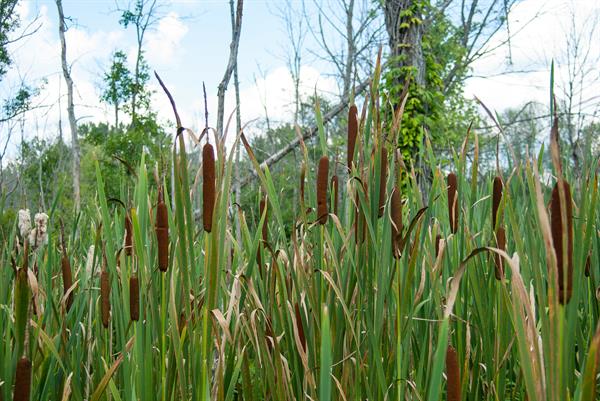 © Erik Danielson source | Original Image ⭷
 © Erik Danielson source | Original Image ⭷
 © Collectors SOS | Original Image ⭷
 © Erik Danielson source | Original Image ⭷
 © Erik Danielson source | Original Image ⭷
 © Collectors SOS | Original Image ⭷
 © Erik Danielson source | Original Image ⭷
Feedback
See something wrong or missing on about Typha angustifolia? Let us know here: (Please include your name and email if at all complicated so we can clarify if needed.)
Cite as...