Copy permalink to share
Ranunculaceae
Actaea

Actaea pachypoda Elliott. Common name: White Baneberry, Dolls'-eyes, White Cohosh. Phenology: Mar-May; Jul-Oct. Habitat: Rich cove forests and slopes. Distribution: QC and MN south to c. GA, FL Panhandle, s. AL, s. MS, e. LA, and OK.

Glossary (beta!)

Section: Actaea.

Origin/Endemic status: Native

Synonymy : = Ar, Can, F, Fl2, FNA3, Il, K4, Mi, Mo3, NE, NS, NY, Pa, POWO, RAB, Tn, Va, W, WH3, Compton, Culham, & Jury (1998); = Actaea alba (L.) Mill. — C, G, GrPl, S, S13, Tat, probably misapplied; > Actaea pachypoda Elliott. Basionym: Actaea pachypoda Elliott 1824 [1821]

Links to other floras: = Actaea pachypoda - FNA3

Show in key(s)

Show parent genus | Show parent in key(s)

Wetland Indicator Status:

  • Atlantic and Gulf Coastal Plain: FACU
  • Eastern Mountains and Piedmont: UPL
  • Midwest: FACU
  • Northcentral & Northeast: UPL

Heliophily : 2

Your browser does not support SVGs

Hover over a shape, letter, icon, or arrow on the map for definition or see the legend.

image of plant© Will Stuart | Original Image ⭷
image of plant© Erik Danielson source | Original Image ⭷
image of plant© Gary P. Fleming | Original Image ⭷
image of plant© Joey Shaw source | Original Image ⭷
image of plant© Radford, Ahles and Bell | Original Image ⭷

Feedback

See something missing or incorrect about Actaea pachypoda? Let us know here:

  1. Please include your name and if possible, email in case when need to clarify what you wrote.
  2. If you opt out of including email, please be as specific as possible (e.g., which photo is incorrect?)
  3. Please do not submit questions asking to identify plants or about horticultural topics (e.g., how do I control an invasive plant in my garden?). Instead, those questions can be submitted here for the Carolinas region only.
  4. Please do not send us feedback about unkeyed species as this work is ongoing.
  5. Please allow time for flora edits to show in our next data release. We greatly appreciate your feedback but may require extra time to research complicated taxonomic issues.

Horticultural Information

NCBG trait

Intro: Erect perennial growing in heavy shade of rich, mesic cove forests and bottomland forests.

Stems: Stems simple and smooth.

Leaves: Leaves 2-3, each 2 times divided into 3 leaflets; leaflets to 2 in. long, variable in shape and lobing, with acute tips and coarsely toothed margins, smooth.

Inforescence:

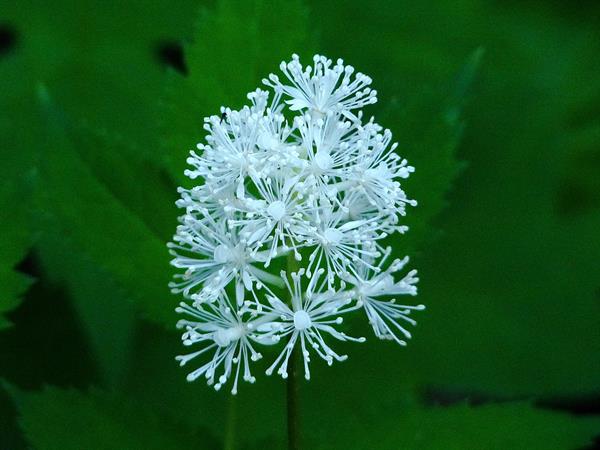
Flowers: Flowers in a compact raceme (to 3 in. long) on a smooth stem above leaves, each flower on a stalk that thickens and becomes red in fruit; flowers white, to ½ in. wide, consisting of an ovary with stout style and numerous, prominent white stamens (plus several indistinct petals).

Fruits: Fruit a round, white berry with black center spot (suggesting dolls' eyes) on a coral red stalk.

Comments: Flowers and leaves of A. racemosa (see p. xx) are very similar.

Height: 1-2 1/2 ft.

plant sale text: Baneberry produces upright racemes of small creamy-white flowers in late spring. Its flowers are delicate in appearance and pleasantly scented. They are followed by bright red berries that are showy for many weeks. This is a choice species that is rarely offered for sale. This southeastern native perennial is tough and long-lived. It is easy to grow and transplants easily as a young container-grown plant. It is difficult to move once it has established its thick root system, so take care to plant it where it can remain long-term. Baneberry typically grows in rich woodlands of the N.C. mountains.

bloom table text:

description: Erect perennial growing in heavy shade of rich, mesic cove forests and bottomland forests.

stems: Stems simple and smooth.

leaves: Leaves 2-3, each 2 times divided into 3 leaflets; leaflets to 2 in. long, variable in shape and lobing, with acute tips and coarsely toothed margins, smooth.

inflorescence:

flowers: Flowers in a compact raceme (to 3 in. long) on a smooth stem above leaves, each flower on a stalk that thickens and becomes red in fruit; flowers white, to ½ in. wide, consisting of an ovary with stout style and numerous, prominent white stamens (plus several indistinct petals).

fruits: Fruit a round, white berry with black center spot (suggesting dolls' eyes) on a coral red stalk.

comments: Flowers and leaves of A. racemosa (see p. xx) are very similar.

cultural notes:

germination code:

native range: eastern North America


0 unsaved edits on this page.