Copy permalink to share
Gentianaceae
Obolaria

not marked as a favorite taxon Obolaria virginica Linnaeus. Common name: Pennywort. Phenology: (Late Feb-) Mar-Jun; May-Jul. Habitat: Nutrient-rich, moist to dry forests, mesic hammocks. Distribution: NJ west to OH, s. IN, and s. IL, south to Panhandle FL (Jefferson County) and se. LA (reported from TX).

Glossary (beta!)

ID notes: The small purplish-green plants are inconspicuous, often nearly hidden under fallen leaves.

Origin/Endemic status: Native

Other Comments: Obolaria has well-developed mycorrhizae and is substantially mycoheterotrophic (Cameron & Bolin 2010).

Synonymy : = Ar, C, F, Fl5, FNA14, G, Il, K4, Mo3, Pa, RAB, S, Tat, Tn, Tx, Va, W, WH3, WV, Gillett (1959). Basionym: Obolaria virginica L. 1753

Links to other floras: = Obolaria virginica - FNA14

Show in key(s)

Show parent genus | Show parent in key(s)

Heliophily : 3

Your browser does not support SVGs

Hover over a shape, letter, icon, or arrow on the map for definition or see the legend.
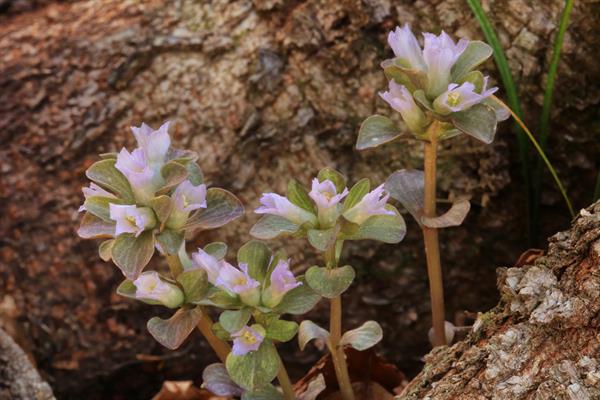
image #1 of Obolaria virginica© Alan M. Cressler | Original Image ⭷
image #3 of Obolaria virginica© Seig, some rights reserved (CC BY), uploaded by Seig source CC-BY | Original Image ⭷
image #4 of Obolaria virginica© abelkinser, some rights reserved (CC BY-NC) source CC-BY-NC, permission granted to NCBG | Original Image ⭷
image #5 of Obolaria virginica© Alaina Krakowiak, some rights reserved (CC BY), uploaded by Alaina Krakowiak source CC-BY | Original Image ⭷
image #6 of Obolaria virginica© Gary P. Fleming | Original Image ⭷
image #7 of Obolaria virginica© Scott Ward | Original Image ⭷
image #8 of Obolaria virginica© Scott Ward, some rights reserved (CC BY), uploaded by Scott Ward source CC-BY | Original Image ⭷
image #9 of Obolaria virginica© Scott Ward, some rights reserved (CC BY), uploaded by Scott Ward source CC-BY | Original Image ⭷
image #10 of Obolaria virginica© Matt Berger, some rights reserved (CC BY), uploaded by Matt Berger source CC-BY | Original Image ⭷
image #11 of Obolaria virginica© Scott Ward, some rights reserved (CC BY), uploaded by Scott Ward source CC-BY | Original Image ⭷
image #12 of Obolaria virginica© Bruce Sorrie
image #13 of Obolaria virginica© RD, some rights reserved (CC BY), uploaded by RD source CC-BY | Original Image ⭷
image #14 of Obolaria virginicano rights reserved, uploaded by Alan Weakley source CC0 | Original Image ⭷
image #15 of Obolaria virginica© jtuttle, all rights reserved, uploaded by jtuttle source | Original Image ⭷
image #16 of Obolaria virginica© Scott Ward, some rights reserved (CC BY), uploaded by Scott Ward source CC-BY | Original Image ⭷
image #18 of Obolaria virginica© DillonM, some rights reserved (CC BY), uploaded by DillonM source CC-BY | Original Image ⭷
image #19 of Obolaria virginica© Chris Hoess, some rights reserved (CC BY-SA), uploaded by Chris Hoess source CC-BY-SA | Original Image ⭷
image #20 of Obolaria virginica© Scott Ward, some rights reserved (CC BY), uploaded by Scott Ward source CC-BY | Original Image ⭷

Feedback

See something missing or incorrect about Obolaria virginica? Let us know here:
  1. Please include your name and if possible, email in case when need to clarify what you wrote.
  2. If you opt out of including email, please be as specific as possible (e.g., which photo is incorrect?)
  3. Please do not submit questions asking to identify plants or about horticultural topics (e.g., how do I control an invasive plant in my garden?). Instead, those questions can be submitted here for the Carolinas region only.
  4. Please do not send us feedback about unkeyed species as this work is ongoing.
  5. Please allow time for flora edits to show in our next data release. We greatly appreciate your feedback but may require extra time to research complicated taxonomic issues.

Horticultural Information

NCBG trait

Intro: Inconspicuous perennial growing in the leaf litter of nutrient-rich, moist to dry forests.

Stems: Stems short, fleshy, simple (very occasionally branched) with an overall purple-green coloration.

Leaves: Leaves opposite and sessile, roundish, less than ½ in. long, thick textured, the lower leaves bract-like.

Inforescence:

Flowers: Flowers solitary, or in clusters of 3, in upper leaf axils; white to lavender; tubular, but cleft to the middle of the tube into 4 diamond-shaped lobes.

Fruits:

Comments: This spring ephemeral is often barely visible above the leaf litter; it has little chlorophyll and is believed to be a mycoheterotroph, obtaining nutrients via underground fungi associated with tree roots.

Height: 1-6 in.

plant sale text:

bloom table text:

description: Inconspicuous perennial growing in the leaf litter of nutrient-rich, moist to dry forests.

stems: Stems short, fleshy, simple (very occasionally branched) with an overall purple-green coloration.

leaves: Leaves opposite and sessile, roundish, less than ½ in. long, thick textured, the lower leaves bract-like.

inflorescence:

flowers: Flowers solitary, or in clusters of 3, in upper leaf axils; white to lavender; tubular, but cleft to the middle of the tube into 4 diamond-shaped lobes.

fruits:

comments: This spring ephemeral is often barely visible above the leaf litter; it has little chlorophyll and is believed to be a mycoheterotroph, obtaining nutrients via underground fungi associated with tree roots.

cultural notes:

germination code:

native range: eastern United States


0 unsaved edits on this page.