Aureolaria pedicularia (Linnaeus) Rafinesque ex Pennell. Common name: Annual Oak-leech. Phenology: Sep-Oct; Nov. Habitat: Oak forests and woodlands; a hemiparasite on Quercus section Lobatae (the red or black oaks). Distribution: ME west to NY and e. MN, south to nw. SC, ne. GA, e. TN, and n. IL.
Origin/Endemic status: Native
Taxonomy Comments: The various named varieties or subspecies need additional study; the variation seems to be too clinal to be practically recognized taxonomically.
Synonymy ⓘ: = FNA17, Mi, NY, Pa, RAB, Tat, Tn, W; = Gerardia pedicularia L. var. pedicularia — F; > Aureolaria pedicularia (L.) Raf. ex Pennell ssp. austromontana (Pennell) Pennell — S, Pennell (1935); > Aureolaria pedicularia (L.) Raf. ex Pennell ssp. caesariensis Pennell — S; > Aureolaria pedicularia (L.) Raf. ex Pennell ssp. carolinensis Pennell — S, Pennell (1935); > Aureolaria pedicularia (L.) Raf. ex Pennell ssp. intercedens (Pennell) Pennell — Pennell (1935); > Aureolaria pedicularia (L.) Raf. ex Pennell ssp. typica (L.) Pennell — Pennell (1935); > Aureolaria pedicularia (L.) Raf. ex Pennell var. ambigens (Fernald) Farw.; > Aureolaria pedicularia (L.) Raf. ex Pennell var. austromontana Pennell — C, G, K4; > Aureolaria pedicularia (L.) Raf. ex Pennell var. intercedens Pennell — C, G, K4, NE; > Aureolaria pedicularia (L.) Raf. ex Pennell var. pedicularia — C, G, K4, NE; > Gerardia pedicularia L. var. austromontana (Pennell) Fernald — F; > Gerardia pedicularia L. var. intercedens (Pennell) Fernald — F; > Gerardia pedicularia L. var. pedicularia — F. Basionym: Gerardia pedicularia L. 1753
Links to other floras: = Aureolaria pedicularia - FNA17
Show parent genus | Show parent in key(s)
Heliophily ⓘ: 6
Hover over a shape, letter, icon, or arrow on the map for definition or see the legend.
© Mark Kluge, some rights reserved (CC BY-NC), uploaded by Mark Kluge source CC-BY-NC, permission granted to NCBG | Original Image ⭷
© Eric M Powell, some rights reserved (CC BY-NC), uploaded by Eric M Powell source CC-BY-NC, permission granted to NCBG | Original Image ⭷
© jtuttle, all rights reserved, uploaded by jtuttle source | Original Image ⭷
© Bruce A. Sorrie | Original Image ⭷
© Sequoia Janirella Wrens, some rights reserved (CC BY-NC), uploaded by Sequoia Janirella Wrens source CC-BY-NC, permission granted to NCBG | Original Image ⭷
© Alan Weakley source | Original Image ⭷
© Eric M Powell, some rights reserved (CC BY-NC), uploaded by Eric M Powell source CC-BY-NC, permission granted to NCBG | Original Image ⭷
© Nate Hartley, some rights reserved (CC BY-NC), uploaded by Nate Hartley source CC-BY-NC, permission granted to NCBG | Original Image ⭷
© Gary P. Fleming | Original Image ⭷
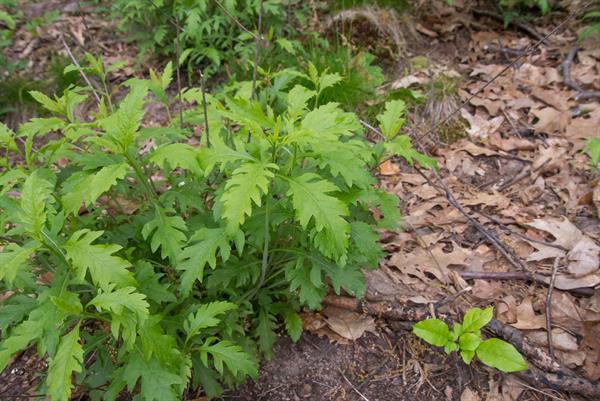
© Eric M Powell, some rights reserved (CC BY-NC), uploaded by Eric M Powell source CC-BY-NC, permission granted to NCBG | Original Image ⭷
© Paul Marcum source
© Mark Kluge, some rights reserved (CC BY-NC), uploaded by Mark Kluge source CC-BY-NC, permission granted to NCBG | Original Image ⭷
© Samuel Brinker, some rights reserved (CC BY-NC), uploaded by Samuel Brinker source CC-BY-NC, permission granted to NCBG | Original Image ⭷
© Michael John Oldham, some rights reserved (CC BY-NC), uploaded by Michael John Oldham source CC-BY-NC, permission granted to NCBG | Original Image ⭷
© Radford, Ahles and Bell | Original Image ⭷Feedback
Horticultural Information
Intro: Erect annual found in oak forests and woodlands.
Stems: Stems much-branched, covered with glandular hairs, at least in lower portions.
Leaves: Leaves opposite, sessile to short-petiolate, lance-shaped, 1-3 in. long, pinnately divided into many toothed or lobed segments, finely sticky-hairy.
Inforescence:
Flowers: Flowers on ascending stalks in upper leaf axils (essentially a raceme), canary yellow, about 1 in. long, bilaterally symmetric and tubular, finely hairy on the outside, marked with red on the inside and divided into 5 spreading, rounded lobes.
Fruits: Fruit a hairy, oval capsule.
Comments: This species is semi-parasitic on oaks and heaths.
Height: 1-4 ft.
plant sale text:
bloom table text:
description: Erect annual found in oak forests and woodlands.
stems: Stems much-branched, covered with glandular hairs, at least in lower portions.
leaves: Leaves opposite, sessile to short-petiolate, lance-shaped, 1-3 in. long, pinnately divided into many toothed or lobed segments, finely sticky-hairy.
inflorescence:
flowers: Flowers on ascending stalks in upper leaf axils (essentially a raceme), canary yellow, about 1 in. long, bilaterally symmetric and tubular, finely hairy on the outside, marked with red on the inside and divided into 5 spreading, rounded lobes.
fruits: Fruit a hairy, oval capsule.
comments: This species is semi-parasitic on oaks and heaths.
cultural notes:
germination code:
native range:
0 unsaved edits on this page.