https://fsus.ncbg.unc.edu/main.php?pg=show-taxon-detail.php&lsid=urn:lsid:ncbg.unc.edu:taxon:{C4AE987E-0FC8-4B66-81B0-19C5A2D2AD52}
 Lobelia inflata Linnaeus. Indian-tobacco. Phen: Jul-Nov. Hab: Fields, meadows, gardens, open woodlands, disturbed areas. Dist: PE west to MN, south to GA, AL, se. MS, e. LA, s. AR, and se. OK.
Origin/Endemic status: Native
Synonymy: = Ar, C, F, G, GrPl, GW2, Il, K1, K3, K4, Mi, Mo2, NE, NY, Pa, RAB, S, Tat, Tn, Va, W, McVaugh (1936a), Spaulding & Barger (2016); > Lobelia inflata L. var. inflata – WV; > Lobelia inflata L. var. simplex (Raf.) Millsp. – WV
Wetland Indicator Status:
- Atlantic and Gulf Coastal Plain: FAC
- Eastern Mountains and Piedmont: FACU
- Great Plains: FAC
- Midwest: FACU
- Northcentral & Northeast: FACU
Heliophily: 6
Hover over a shape, letter, icon, or arrow on the map for definition or see the legend.
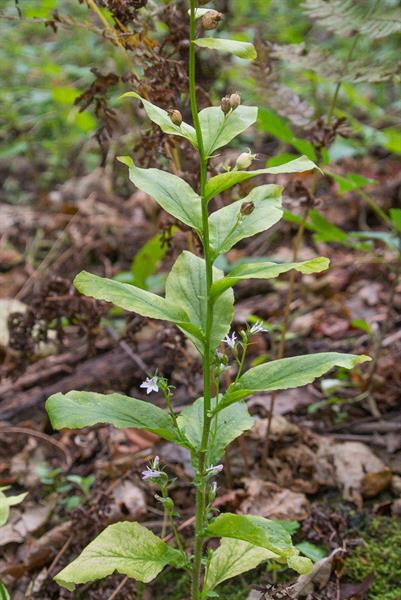 © Erik Danielson source | Original Image ⭷
 © theo_witsell, some rights reserved (CC BY-NC), uploaded by theo_witsell source CC-BY-NC, permission granted to NCBG | Original Image ⭷
 © Richard & Teresa Ware CC-BY-NC, permission granted to NCBG | Original Image ⭷
 © Gary P. Fleming
 © Erik Danielson source | Original Image ⭷
 © Richard & Teresa Ware CC-BY-NC, permission granted to NCBG | Original Image ⭷
 © Joey Shaw source | Original Image ⭷
 © Erik Danielson source | Original Image ⭷
Feedback
See something wrong or missing on about Lobelia inflata? Let us know here: (Please include your name and email if at all complicated so we can clarify if needed.)
Cite as...