Solidago arguta W. Aiton. Subgenus: Pleiactila. Section: Argutae. Subsection: Argutae. Common name: Forest Goldenrod. Phenology: Aug-Oct. Habitat: Woodlands, woodland borders, bluffs, sloped forests, road margins or cut-over woods. Distribution: S. ME and s. ON south to NC and TN; disjunct in s. IL, MO, and (?) AR.
Origin/Endemic status: Native
Taxonomy Comments: Some western populations have been called S. arguta var. neurolepis or S. neurolepis (see synonymy); this has alternately been considered to be a hybrid.
Synonymy ⓘ: = F, G, Il, S, Tat, Semple et al (2021); = Solidago arguta Aiton ssp. arguta — C, SE1, W; = Solidago arguta Aiton ssp. arguta var. arguta — FNA20; = Solidago arguta Aiton — NE, NY, Pa, POWO, Tn, Va; < Solidago arguta Aiton — RAB; < Solidago arguta Aiton — Johnson (1995); > Solidago arguta Aiton — K4; > Solidago arguta Aiton var. neurolepis (Fernald) Steyerm. — K4; > Solidago neurolepis Fernald — F. Basionym: Solidago arguta Aiton 1789
Links to other floras: = Solidago arguta ssp. arguta var. arguta - FNA20
Show parent genus | Show parent in key(s)
Wetland Indicator Status:
- Atlantic and Gulf Coastal Plain: UPL (taxonomic split from wetland indicator species)
- Eastern Mountains and Piedmont: UPL (taxonomic split from wetland indicator species)
- Great Plains: FACU (taxonomic split from wetland indicator species)
- Midwest: UPL (taxonomic split from wetland indicator species)
- Northcentral & Northeast: FACU (taxonomic split from wetland indicator species)
Heliophily ⓘ: 5
Hover over a shape, letter, icon, or arrow on the map for definition or see the legend.
© Gary P. Fleming | Original Image ⭷
© Erik Danielson source | Original Image ⭷
© Alan Weakley source | Original Image ⭷
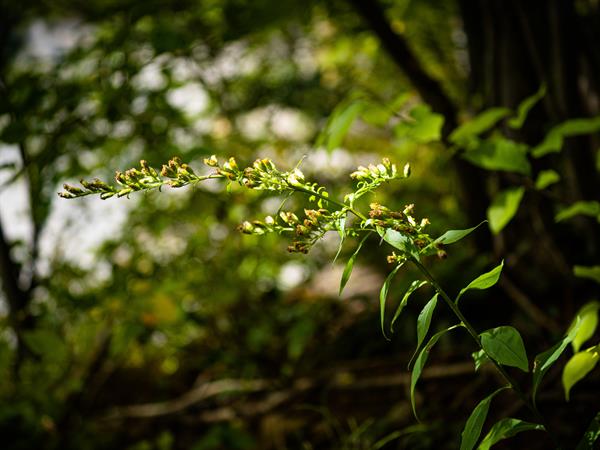
© Erik Danielson source | Original Image ⭷Feedback
See something missing or incorrect about Solidago arguta? Let us know here:
- Please include your name and if possible, email in case when need to clarify what you wrote.
- If you opt out of including email, please be as specific as possible (e.g., which photo is incorrect?)
- Please do not submit questions asking to identify plants or about horticultural topics (e.g., how do I control an invasive plant in my garden?). Instead, those questions can be submitted here for the Carolinas region only.
- Please do not send us feedback about unkeyed species as this work is ongoing.
- Please allow time for flora edits to show in our next data release. We greatly appreciate your feedback but may require extra time to research complicated taxonomic issues.
Horticultural Information
Intro: Erect to arching, rhizomatous perennial of moist to dry upland forests, woodlands, barrens and clearings.
Stems: Stems sometimes obscurely angled, branched above, mostly smooth.
Leaves: Leaves basal and alternate on the stem, winged-petiolate, elliptic to oval, 2-5 in. long (reduced and sessile upward), toothed, smooth to slightly rough-hairy.
Inforescence:
Flowers: Composite flowers (heads) in an open, leafy, pyramidal array of branches at top of plant, the heads mostly on 1 side of each branch; heads consisting of 2-8 small, yellow ray florets encircling a small center disk of 8-20 tiny, yellow, tubular florets. 3-4 series of tiny bracts surround the cup-shaped base of each head.
Fruits:
Comments: Several varieties can be distinguished in our region with the help of technical manuals: var. caroliniana, var. arguta, and var. boottii. Image here is of S. arguta var. caroliniana.
Height: 2-3 ft.
plant sale text:
bloom table text:
description: Erect to arching, rhizomatous perennial of moist to dry upland forests, woodlands, barrens and clearings.
stems: Stems sometimes obscurely angled, branched above, mostly smooth.
leaves: Leaves basal and alternate on the stem, winged-petiolate, elliptic to oval, 2-5 in. long (reduced and sessile upward), toothed, smooth to slightly rough-hairy.
inflorescence:
flowers: Composite flowers (heads) in an open, leafy, pyramidal array of branches at top of plant, the heads mostly on 1 side of each branch; heads consisting of 2-8 small, yellow ray florets encircling a small center disk of 8-20 tiny, yellow, tubular florets. 3-4 series of tiny bracts surround the cup-shaped base of each head.
fruits:
comments: Several varieties can be distinguished in our region with the help of technical manuals: var. caroliniana, var. arguta, and var. boottii. Image here is of S. arguta var. caroliniana.
cultural notes:
germination code:
native range:
0 unsaved edits on this page.