| Family | Scientific Name | Common Name | Habitat | Distribution | Image |
|---|---|---|---|---|---|
| Alliaceae | Allium allegheniense | Allegheny Onion | In thin soils around outcrops, generally of mafic rocks (such as amphibolite or hornblende gneiss) or calcareous rocks, primarily at moderate to fairly high elevations (1000-1600m). | Known from w. VA and e. WV south through w. NC to n. GA. |  |
| Alliaceae | Allium ampeloprasum | Wild Leek, Yorktown Onion, Elephant Garlic | Roadsides and other disturbed areas. | Native of Eurasia. |  |
| Alliaceae | Allium burdickii | Narrow-leaved Ramps, White Ramps, Wild Leek | Northern hardwood forests, primarily at higher elevations than A. tricoccum, also in cove forests and rich slopes. | ME west to ND and south to NJ, and in the Mountains to w. VA, w. NC, and n. GA (but see note about taxonomic complexity within what is being for now treated as Allium burdickii). |  |
| Alliaceae | Allium canadense | Wild Onion | Bottomland forests, pastures, roadsides. | NB west to ND, south to c. peninsular FL and TX. |  |
| Alliaceae | Allium cepa | Garden Onion | Persisting from gardens, or appearing around compost or trash piles. | Native to c. Asia. |  |
| Alliaceae | Allium cernuum | Nodding Onion | Generally in open woodlands or around outcrops of shale, mafic, ultramafic, or calcareous rocks, in the mountains at low elevations. | NY, MI, MN, and BC, south to GA and AZ; the distribution is oddly fragmented into largely Rocky Mountain, Ozarkian, and Appalachian segments, and it is quite possible that cryptic taxa are involved. | |
| Alliaceae | Allium cuthbertii | Cuthbert's Onion | Longleaf pine sandhills, other dry sandy areas. | C. SC south through GA and AL to ne. FL. Previous reports from NC are based on misidentifications or populations now recognized as Allium keeverae. | |
| Alliaceae | Allium drummondii | Drummond's Onion, Prairie Onion | Prairies. | NE and ne. CO south to sw. AR, e. TX, s. TX, NM, and n. Mexico (CHH, COA, DGO, NLE, TAM). |  |
| Alliaceae | Allium elmendorfii | Elmendorf's Onion | Sandy soils, openings in post oak woodlands, primarily in the Carrizo Formation. | Endemic to sc. TX to se. TX: Aransas, Atascosa, Bee, Bexar, Gonzales, Guadalupe, Kenedy, Llano, Nueces, Refugio, San Patricio and Wilson counties (Carr 2016). | |
| Alliaceae | Allium fistulosum | Welsh Onion, Japanese Bunching Onion, Cibol, Chibbles | Waif from garden cultivation. | Native of China. | |
| Alliaceae | Allium fraseri | Fraser's Wild Onion | Rocky areas, woodlands, prairies. | SD south to c. TX. |  |
| Alliaceae | Allium hyacinthoides | Fragrant Wild Onion | Calcareous prairies. | OK south to c. TX. | |
| Alliaceae | Allium keeverae | Keever's Onion | In thin soils around rock outcrops, receiving nutrient-rich seepage and occurring with many calciphiles. | Endemic to the Brushy Mountains in the nw. Piedmont of NC (Alexander and Wilkes counties). |  |
| Alliaceae | Allium kunthii | Kunth's Onion | S. TX, s. NM, and s. AZ south into Mexico. | ||
| Alliaceae | Allium lavendulare | Ozark Onion, Tall Pink Glade Onion | Glades, prairies, bluffs, oak savannas, disturbed areas. | MO and e. SD south to AR and OK; disjunct in Nashville Basin of TN (D. Estes, pers. comm. 2020). |  |
| Alliaceae | Allium mobilense | Mobile Onion | Dry woodlands, prairies. | C. NC south to ne. FL and Panhandle FL, west to TX. |  |
| Alliaceae | Allium neapolitanum | White Garlic, Daffodil Garlic, Naples Garlic | Suburban woodlands, other disturbed areas. | Native of Eurasia. Reported from Franklin County, FL (Wunderlin & Hansen 2011), Marengo County, AL (Keener 2012), and other Gulf Coast states (Kartesz 2010). |  |
| Alliaceae | Allium nigrum | Black Garlic | Waif from garden cultivation. | Native of w. Asia. |  |
| Alliaceae | Allium oleraceum | Field Garlic | Disturbed areas. | Native of Europe. |  |
| Alliaceae | Allium oxyphilum | Shale barrens, on strongly acidic shales. | Endemic to a small area of WV (Greenbrier, Mercer, Monroe, and Summers counties) and VA (Alleghany and Craig counties). |  | |
| Alliaceae | Allium perdulce var. perdulce | Fraser's Onion | Sandy or gravelly prairies. | W. IA and SD south to c. TX and e. NM. | |
| Alliaceae | Allium porrum | Leek | Cultivated, rarely persistent as a waif. | Native of Mediterranean Europe. |  |
| Alliaceae | Allium runyonii | Runyon's Onion | Sandy soils. | S. TX. | |
| Alliaceae | Allium sativum | Garlic | Gardens, trash heaps, fields; commonly cultivated, rarely occurring as a waif or persistent in gardens. | Native of Eurasia. |  |
| Alliaceae | Allium schoenoprasum var. schoenoprasum | Chives | Disturbed areas, a waif from garden use. | Native of Eurasia. |  |
| Alliaceae | Allium species 1 | Savanna Onion | Wet savannas over coquina limestone (marl). | This remarkable Coastal Plain relative of A. cernuum was first discovered in 1981 by Steve Leonard in Pender County; it has since been found in similar sites in Onslow and Brunswick counties, always associated with other endemic species of primarily montane genera, such as Thalictrum cooleyi and Parnassia caroliniana |  |
| Alliaceae | Allium species 3 | Crestless Wild Onion | Poorly drained sites on sandy substrates within coastal prairies of the Coastal Bend area (Carr 2016). | Endemic in s. T: Goliad, Matagorda (?), Nueces (?), Refugio, San Patricio and Wilson (?) counties (Carr 2016). | |
| Alliaceae | Allium species 4 | Limestone glades and barrens. | Sc. KY south through c. and e. TN to nw. GA and n. AL. |  | |
| Alliaceae | Allium speculae | Flatrock Onion | Seepy edges of vegetation mats on Lithonia granitic gneiss and on sandstone in ne. AL. | Endemic to wc. GA and ne. AL. | |
| Alliaceae | Allium sphaerocephalon | Round-head Leek, Flowering Onion, Ballhead Onion | Disturbed areas, from horticultural use. | Native of Mediterranean Europe, w. Asia, and n. Africa. |  |
| Alliaceae | Allium stellatum | Glade Onion, Prairie Onion | Limestone glades, calcareous prairies, calcareous barrens. | ON and SK south to n. AR and e. TX; disjunct east of the Mississippi in c. TN, c. KY, and nw. GA. |  |
| Alliaceae | Allium textile | White Wild Onion |  | ||
| Alliaceae | Allium tricoccum | Ramps, Red Ramps, Wild Leek, Rampscallions | Cove forests and mesic slope forests. | NS and ND south to n. GA, n. AL, and MO. |  |
| Alliaceae | Allium tuberosum | Chinese Chives, Oriental Garlic | Dunes, disturbed areas. | Native of e. Asia. See Barger et al. (2012) for additional information on the AL occurrence. |  |
| Alliaceae | Allium vineale | Field Garlic, Onion-grass, Wild Onion | Lawns, pastures, other disturbed places. | Native of Eurasia. | 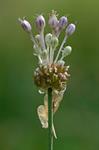 |
Cite as...