Click the number at the start of a key lead to highlight both that lead and its corresponding lead. Click again to show only the two highlighted leads. Click a third time to return to the full key with the selected leads still highlighted.
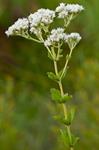
 Show caption*© Alan Cressler: Ampelaster carolinianus, Juniper Creek, Juniper Prairie Wilderness, Ocala National Forest, Marion County, Florida 4 by Alan Cressler Show caption*© Alan Cressler: Ampelaster carolinianus, Juniper Creek, Juniper Prairie Wilderness, Ocala National Forest, Marion County, Florida 4 by Alan Cressler 1 Plant a shrub or liana (woody vine), definitely with woody growth well above ground level |
1 Plant an annual, biennial, or perennial, lacking woody growth above ground level (or suffrutescent at the base). |
..2 Leaves opposite or whorled, at least on the lower stem nodes (the leaves higher on the stem sometimes alternate). |
....3 Heads discoid or disciform, with disk florets only |
....3 Heads radiate, with both ray and disk florets present. |
..2 Leaves either alternate (not opposite even at lower nodes of the stem) or basal only (the heads on scapiform stems). |
......4 Heads borne solitary on scapes, or many in a raceme on stems with only scale-like bracts |
......4 Heads borne on stems with leaves, the leaves alternate, opposite, or whorled on the stem, and sometimes also well developed basal leaves or rosettes. |
........5 Heads liguliflorous (composed of ligulate florets); sap usually milky |
........5 Heads discoid, disciform, radiant, or radiate (not only composed of ligulate florets); sap usually clear. |
..........6 Heads discoid or disciform (composed primarily of disc florets and peripheral filiform florets), OR heads radiant, essentially composed of ordinary disc florets and dilated periphereal florets (these peripheral florets dilated, perfect, pistllate, or netural, but lacking broadly expanded laminae of ordinary ray florets). |
............ 7 Leaves spiny-margined, phyllaries usually spine-tipped; disk flowers pink (rarely blue or yellow) |
............ 7 Leaves not spiny-margined; phyllaries spine-tipped or not; disk flowers variously colored (including pink) |
............ ..8 Pappus none or rudimentary [look at summit of achenes or ovary] |
............ ..8 Pappus well-developed, of bristles, awns, scales, or a combination of these. |
............ ....9 Pappus of bristles only (the bristles smooth, barbellulate, barbellate, or plumose) |
............ ....9 Pappus wholly or partially of scales (broad to narrow, sometimes almost bristle-like, but at least in part flattened) or awns (these often barbed) |
..........6 Heads radiate, with both central disc and peripheral ray florets, the ray florets with prominent laminae. |
............ ......10 Rays yellow, cream, orange, or rarely red-tinged. |
............ ........11 Receptacles paleate (with chaff) [best seen by removing flowers or achenes from the receptacle] |
............ ........11 Receptacles naked (epaleate), rarely with imbedded bristles (or Gaillardia sometimes with short setae 1-6 mm long but these much shorter than the pappus scales of the cypselae) |
............ ......10 Rays white, pink, purple, or bluish. |
............ ..........12 Pappus none or rudimentary [look at summit of achenes or ovary] |
............ ..........12 Pappus well-developed, of bristles, awns, scales, or a combination of these. |
............ ............ 13 Pappus of bristles only (the bristles smooth, barbellulate, barbellate, or plumose) |
............ ............ 13 Pappus wholly or partially of scales (broad to narrow, sometimes almost bristle-like, but at least in part flattened) or awns (these often barbed) |