Celtis laevigata Willdenow. Common name: Southern Hackberry, Sugarberry. Phenology: Apr-May; Aug-Oct. Habitat: Bottomland forests, especially on natural levees, upland calcareous forests and woodlands, shell middens. Distribution: MD, WV, IN, IL, MO and KS south to s. FL and TX. Reported for many states in Mexico by Villaseñor (2016), but unclear what the circumscription being applied there is.
Origin/Endemic status: Native
Synonymy ⓘ: = Celtis laevigata Willd. var. laevigata — Mo3; = Celtis mississippiensis Bosc — S; = n/a — Tat; < Celtis laevigata Willd. — Ar, C, FNA3, G, GW2, K4, Mex, POWO, RAB, Tn, Va, W, WH3; > Celtis laevigata Willd. var. laevigata — F, GrPl, Il, NS, Tx; > Celtis laevigata Willd. var. texana Sarg. — F, GrPl, Il, NS, Tx. Basionym: Celtis laevigata Willd. 1814
Links to other floras: < Celtis laevigata - FNA3
Show parent genus | Show parent in key(s)
Wetland Indicator Status:
- Atlantic and Gulf Coastal Plain: FACW (taxonomic split from wetland indicator species)
- Eastern Mountains and Piedmont: FACW (taxonomic split from wetland indicator species)
- Great Plains: FAC (taxonomic split from wetland indicator species)
- Midwest: FACW (taxonomic split from wetland indicator species)
Heliophily ⓘ: 5
Hover over a shape, letter, icon, or arrow on the map for definition or see the legend.
© Michelle W., some rights reserved (CC BY), uploaded by Michelle W. source CC-BY | Original Image ⭷
© Richard & Teresa Ware CC-BY-NC, permission granted to NCBG | Original Image ⭷
© Gary P. Fleming | Original Image ⭷
© Mary Keim, some rights reserved (CC BY-NC-SA) source CC-BY-NC-SA, permission granted to NCBG | Original Image ⭷
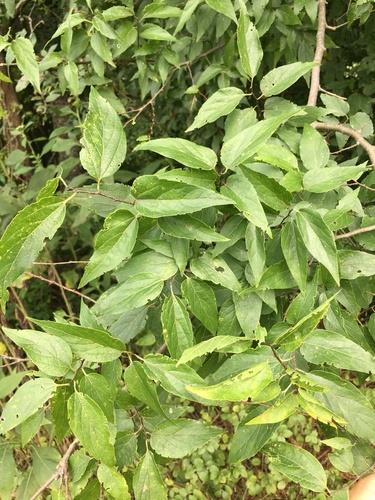
© Joey Shaw source | Original Image ⭷
© abelkinser, some rights reserved (CC BY-NC) source CC-BY-NC, permission granted to NCBG | Original Image ⭷
© Keith Bradley | Original Image ⭷
© Scott Ward | Original Image ⭷
© abelkinser, some rights reserved (CC BY-NC) source CC-BY-NC, permission granted to NCBG | Original Image ⭷
© Aidan Campos source | Original Image ⭷
© Richard & Teresa Ware CC-BY-NC, permission granted to NCBG | Original Image ⭷
© Keith Bradley | Original Image ⭷
© Richard & Teresa Ware CC-BY-NC, permission granted to NCBG | Original Image ⭷
© Bruce A. Sorrie | Original Image ⭷
© Aidan Campos source | Original Image ⭷
© Scott Ward | Original Image ⭷Feedback
See something missing or incorrect about Celtis laevigata? Let us know here:
- Please include your name and if possible, email in case when need to clarify what you wrote.
- If you opt out of including email, please be as specific as possible (e.g., which photo is incorrect?)
- Please do not submit questions asking to identify plants or about horticultural topics (e.g., how do I control an invasive plant in my garden?). Instead, those questions can be submitted here for the Carolinas region only.
- Please do not send us feedback about unkeyed species as this work is ongoing.
- Please allow time for flora edits to show in our next data release. We greatly appreciate your feedback but may require extra time to research complicated taxonomic issues.
Horticultural Information
Intro: A medium to large-sized deciduous tree, usually 20-30 m (65-100 ft.) tall when mature. Older twigs have chambered pith, which sometimes becomes hollow. Bark is usually light gray and smooth, but often bears a few scattered to many warty outgrowths. Leaves are alternate, typically small to medium sized (6-8 cm long), usually twice as long wide, with a long-pointed tip. Leaves are usually lanceolate, ovate or oval shaped, and often curve to one side. Leaf margins are mostly untoothed, but a few (rarely many) small teeth may be present. Leaves bear 3 prominent veins that branch from the base of the leaf blade. Flowers occur in small clusters, with functionally unisexual female and male flowers on the same tree, occasionally with male and females flowers combined. Fruits are small (0.4-0.9 cm long) drupes that are usually orangish-red in color, sometimes purple. Southern Hackberry occurs most commonly in bottomland forests of the Piedmont, where it often grows along the edges of rivers and streams.
Stems: Pith chambered or continuous or hollow. Young twigs (1-year-old or less) brown or green or reddish-brown, glabrous or glabrate or pubescent. Twigs (2-4 years old) glabrous. Leaf scars crescent-shaped or oval, bundle scars 3 per leaf scar, stipule scars inconspicuous. Bark of mature trunks ridged or smooth or warty. Buds axillary, brown or reddish-brown, 1.5-3.2 mm long, ovoid, sharp, pubescent, puberulent, bud scales imbricate.
Leaves: Leaves deciduous, simple, petiolate, alternate, distichous, (4-)6-8(-15) cm long, (1.1-)3-4(-6) cm wide, falcate or lanceolate or oval or ovate, leaf margins entire or dentate or serrate or ciliate, leaf apices acuminate or acute or caudate, leaf bases cuneate or oblique or obtuse or rounded. Leaf upper surface green or yellow-green, glabrous or glabrate. Leaf lower surface green or yellow-green, glabrous or glabrate. Leaf venation palmate. Petioles 0.6-1.3 cm long, glabrous. Stipules present, caducous.
Inforescence: Inflorescences axillary, fascicles or flowers solitary, flowers sessile or stalked.
Flowers: Flowers unisexual or pistillate or staminate, hypogynous. Perianth. Calyx radially symmetric, aposepalous. Sepals 4-6 per flower, green, lanceolate or ovate, glabrous or pubescent, puberulent, persistent. Corolla absent. Androecium. Stamens 4-6 per flower, separate. Gynoecium. Ovaries superior, pistils 1 per flower. Gynoecium syncarpous, 2 carpels per flower, styles 2 per pistil, placentation apical.
Fruits: Fruits drupes, 0.4-0.9 cm long, brown or orange or purple or red or yellow, fruit maturation 1 years.
Comments:
Height: 65-100 ft.
plant sale text: Southern hackberry is distinguished by its unusual, corky bark with warty protuberances. It produces abundant reddish-purple drupes in the fall which birds relish. Southern hackberry prefers a moist but well-drained sandy or clay loam soil, but it will tolerate a wide range of soil conditions and is well suited to growing in an urban environment. Several species of moth and butterflies rely on this tree species as a larval host and nectar source.
bloom table text:
description: A medium to large-sized deciduous tree, usually 20-30 m (65-100 ft.) tall when mature. Older twigs have chambered pith, which sometimes becomes hollow. Bark is usually light gray and smooth, but often bears a few scattered to many warty outgrowths. Leaves are alternate, typically small to medium sized (6-8 cm long), usually twice as long wide, with a long-pointed tip. Leaves are usually lanceolate, ovate or oval shaped, and often curve to one side. Leaf margins are mostly untoothed, but a few (rarely many) small teeth may be present. Leaves bear 3 prominent veins that branch from the base of the leaf blade. Flowers occur in small clusters, with functionally unisexual female and male flowers on the same tree, occasionally with male and females flowers combined. Fruits are small (0.4-0.9 cm long) drupes that are usually orangish-red in color, sometimes purple. Southern Hackberry occurs most commonly in bottomland forests of the Piedmont, where it often grows along the edges of rivers and streams.
stems: Pith chambered or continuous or hollow. Young twigs (1-year-old or less) brown or green or reddish-brown, glabrous or glabrate or pubescent. Twigs (2-4 years old) glabrous. Leaf scars crescent-shaped or oval, bundle scars 3 per leaf scar, stipule scars inconspicuous. Bark of mature trunks ridged or smooth or warty. Buds axillary, brown or reddish-brown, 1.5-3.2 mm long, ovoid, sharp, pubescent, puberulent, bud scales imbricate.
leaves: Leaves deciduous, simple, petiolate, alternate, distichous, (4-)6-8(-15) cm long, (1.1-)3-4(-6) cm wide, falcate or lanceolate or oval or ovate, leaf margins entire or dentate or serrate or ciliate, leaf apices acuminate or acute or caudate, leaf bases cuneate or oblique or obtuse or rounded. Leaf upper surface green or yellow-green, glabrous or glabrate. Leaf lower surface green or yellow-green, glabrous or glabrate. Leaf venation palmate. Petioles 0.6-1.3 cm long, glabrous. Stipules present, caducous.
inflorescence: Inflorescences axillary, fascicles or flowers solitary, flowers sessile or stalked.
flowers: Flowers unisexual or pistillate or staminate, hypogynous. Perianth. Calyx radially symmetric, aposepalous. Sepals 4-6 per flower, green, lanceolate or ovate, glabrous or pubescent, puberulent, persistent. Corolla absent. Androecium. Stamens 4-6 per flower, separate. Gynoecium. Ovaries superior, pistils 1 per flower. Gynoecium syncarpous, 2 carpels per flower, styles 2 per pistil, placentation apical.
fruits: Fruits drupes, 0.4-0.9 cm long, brown or orange or purple or red or yellow, fruit maturation 1 years.
comments:
cultural notes:
germination code:
native range: southeastern United States
0 unsaved edits on this page.