 Carpinus caroliniana Walter var. caroliniana . Coastal American Hornbeam, Muscletree, Leantree, Lechillo, Water Beech. Phen: Mar-May; Sep-Oct. Hab: Streambanks, riverbanks, bottomland forests, lower slopes, maritime forests. Dist: E. VA south to c. peninsular FL, west to e. TX, and north in the inland to s. MO and s. IL.
Origin/Endemic status: Endemic
Taxonomy Comments: The treatment as two taxa was established by Furlow (1987a, 1987b) largely through statistical methods. The two taxa have some morphologic and phytogeographic coherence, but intergradation appears to be extensive, and individual specimens (in the herbarium) or trees (in the field) may not be readily identifiable to variety.
Synonymy: = C, F, Il; = Carpinus caroliniana Walter ssp. caroliniana – Ar, Fl2, FNA3, K1, K3, K4, Furlow (1987b), Furlow (1990); < Carpinus caroliniana Walter – G, GW2, NcTx, RAB, S, S13, Tn, Tx, Va, WH3, Hardin (1971a)
Wetland Indicator Status:
- Atlantic and Gulf Coastal Plain: FAC (taxonomic split from wetland indicator species)
- Eastern Mountains and Piedmont: FAC (taxonomic split from wetland indicator species)
- Great Plains: FAC (taxonomic split from wetland indicator species)
- Midwest: FAC (taxonomic split from wetland indicator species)
- Northcentral & Northeast: FAC (taxonomic split from wetland indicator species)
Heliophily: 4
Hover over a shape, letter, icon, or arrow on the map for definition or see the legend.
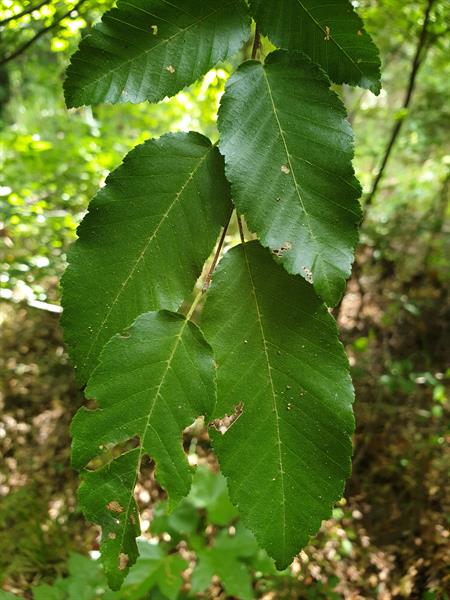 © Étienne Léveillé-Bourret, some rights reserved (CC BY-NC), uploaded by Étienne Léveillé-Bourret source CC-BY-NC, permission granted to NCBG | Original Image ⭷
 © Étienne Léveillé-Bourret, some rights reserved (CC BY-NC), uploaded by Étienne Léveillé-Bourret source CC-BY-NC, permission granted to NCBG | Original Image ⭷
 © Alan Weakley source | Original Image ⭷
Feedback
See something wrong or missing on about Carpinus caroliniana var. caroliniana? Let us know here: (Please include your name and email if at all complicated so we can clarify if needed.)
Cite as...