Silene stellata (Linnaeus) W.T. Aiton. Common name: Starry Campion, Widow's-frill. Phenology: Jun-Aug. Habitat: Dry to mesic forests, rock outcrops. Distribution: CT and VT west to SD, south to c. GA and TX.
Origin/Endemic status: Native
Synonymy ⓘ: = Ar, Can, F, FNA5, GrPl, K4, NcTx, NE, NY, Pa, RAB, S, S13, Tat, Tn, Tx, Va, W, WV; > Silene stellata (L.) W.T.Aiton var. scabrella E.J.Palmer & Steyerm. — C, G, Il, Mi; > Silene stellata (L.) W.T.Aiton var. stellata — C, G, Il, Mi. Basionym: Cucubalus stellatus L. 1753
Links to other floras: = Silene stellata - FNA5
Show parent genus | Show parent in key(s)
Heliophily ⓘ: 5
Hover over a shape, letter, icon, or arrow on the map for definition or see the legend.
© Keith Bradley | Original Image ⭷
© Richard & Teresa Ware CC-BY-NC, permission granted to NCBG | Original Image ⭷
© Radford, Ahles and Bell | Original Image ⭷Feedback
See something missing or incorrect about Silene stellata? Let us know here:
- Please include your name and if possible, email in case when need to clarify what you wrote.
- If you opt out of including email, please be as specific as possible (e.g., which photo is incorrect?)
- Please do not submit questions asking to identify plants or about horticultural topics (e.g., how do I control an invasive plant in my garden?). Instead, those questions can be submitted here for the Carolinas region only.
- Please do not send us feedback about unkeyed species as this work is ongoing.
- Please allow time for flora edits to show in our next data release. We greatly appreciate your feedback but may require extra time to research complicated taxonomic issues.
Horticultural Information
Intro: Erect or ascending perennial of dry to mesic forests and rock outcrops.
Stems: Stems stiff, branched from the base, smooth to densely hairy.
Leaves: Leaves opposite on upper- and lower-most stem, mid-stem leaves in whorls of mostly 4; sessile to short petiolate; lance-shaped or oval; tapering to a sharp point; to 4 in. long; finely hairy beneath and smooth to rough above.
Inforescence:
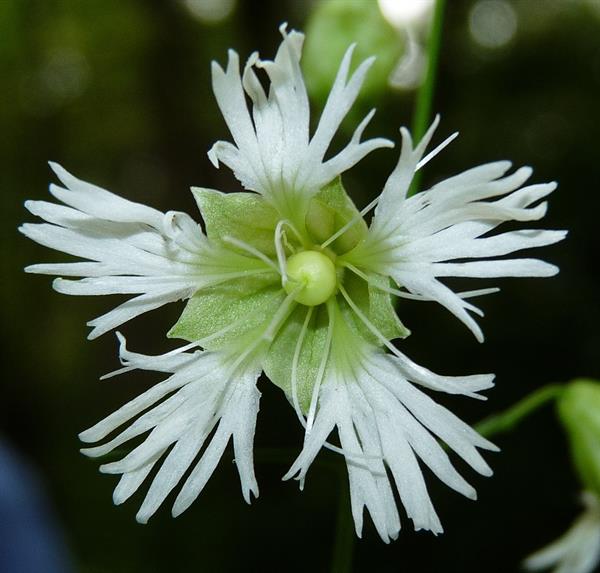
Flowers: Flowers in open panicles; white; 3/4-1 in.wide; consisting of 5 spreading petals that are deeply and unevenly divided into 8-12 segments, giving the flower a fringed appearance, and a slightly inflated, smooth to hairy, bell-shaped calyx tube with 5 triangular lobes.
Fruits: Fruit a rounded capsule.
Comments: The scentless flowers are often closed during the bright light of midday.
Height: 1-4 ft.
plant sale text:
bloom table text:
description: Erect or ascending perennial of dry to mesic forests and rock outcrops.
stems: Stems stiff, branched from the base, smooth to densely hairy.
leaves: Leaves opposite on upper- and lower-most stem, mid-stem leaves in whorls of mostly 4; sessile to short petiolate; lance-shaped or oval; tapering to a sharp point; to 4 in. long; finely hairy beneath and smooth to rough above.
inflorescence:
flowers: Flowers in open panicles; white; 3/4-1 in.wide; consisting of 5 spreading petals that are deeply and unevenly divided into 8-12 segments, giving the flower a fringed appearance, and a slightly inflated, smooth to hairy, bell-shaped calyx tube with 5 triangular lobes.
fruits: Fruit a rounded capsule.
comments: The scentless flowers are often closed during the bright light of midday.
cultural notes:
germination code:
native range: eastern & central United States
0 unsaved edits on this page.