Copy permalink to share
Caryophyllaceae
Stellaria

Stellaria pubera Michaux. Common name: Star Chickweed, Common Starwort, Giant Chickweed, Great Chickweed. Phenology: Apr-Jun. Habitat: Bottomland forests, moist slopes, coves, hammocks. Distribution: NJ west to IL, south to Panhandle FL and AL.

Glossary (beta!)

ID notes: Both Stellaria corei and Stellaria pubera have an interesting seasonal growth form, producing short and relatively small-leaved flowering shoots in the spring (which wither following fruiting), followed by taller, more vigorous summer shoots with larger and tougher leaves and lacking flowers, which persist until autumn. Some of the description in various manuals of differences in petiole length and leaf size and shape between the two species is obscured or complicated by these seasonal differences; more careful observation is needed.

Origin/Endemic status: Native

Synonymy : = FNA5, G, Il, K4, NY, Pa, RAB, Tat, Tn, Va, W, WH3, WV; = Alsine pubera (Michx.) Britton — S, S13; = Stellaria puber Michx. — Fl4, K4; = Stellaria pubera Michx. var. pubera — C, F. Basionym: Stellaria pubera Michx. 1803

Links to other floras: = Stellaria pubera - FNA5

Show in key(s)

Show parent genus | Show parent in key(s)

Heliophily : 3

Your browser does not support SVGs

Hover over a shape, letter, icon, or arrow on the map for definition or see the legend.
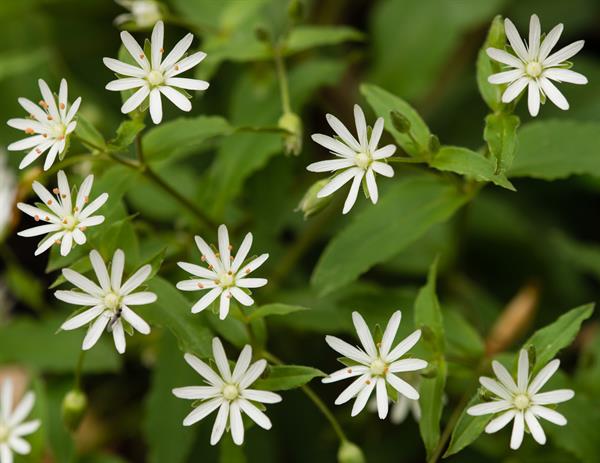
image of plant© Keith Bradley | Original Image ⭷
image of plant© Joey Shaw source | Original Image ⭷
image of plant© Mark Eanes, some rights reserved (CC BY), uploaded by Mark Eanes source CC-BY | Original Image ⭷
image of plant© Joey Shaw source | Original Image ⭷
image of plant© Emily Turteltaub Nelson, some rights reserved (CC BY), uploaded by Emily Turteltaub Nelson source CC-BY | Original Image ⭷
image of plant© Joey Shaw source | Original Image ⭷
image of plant© Edwin Bridges | Original Image ⭷
image of plant© Bruce A. Sorrie | Original Image ⭷

Feedback

See something missing or incorrect about Stellaria pubera? Let us know here:

  1. Please include your name and if possible, email in case when need to clarify what you wrote.
  2. If you opt out of including email, please be as specific as possible (e.g., which photo is incorrect?)
  3. Please do not submit questions asking to identify plants or about horticultural topics (e.g., how do I control an invasive plant in my garden?). Instead, those questions can be submitted here for the Carolinas region only.
  4. Please do not send us feedback about unkeyed species as this work is ongoing.
  5. Please allow time for flora edits to show in our next data release. We greatly appreciate your feedback but may require extra time to research complicated taxonomic issues.

Horticultural Information

NCBG trait

Intro: Erect to ascending or reclining perennial of bottomland forests, moist slopes, coves and hammocks.

Stems: Stems 4-angled, branching, with 2 lines of fine hairs.

Leaves: Leaves opposite, sessile to short-petiolate at lower stem, oval or lance-shaped, 3/4-4 in. long (the larger ones on non-flowering stems), usually hairy above.

Inforescence:

Flowers: Flowers in open, leafy clusters at ends of stems; white; 1/4-5/8 in. wide; consisting of 5 spreading petals that are so deeply notched they appear to be 10, and 10 reddish-tipped stamens.

Fruits: Fruit a round capsule.

Comments:

Height: 4-16 in.

plant sale text: A name like star chickweed can strike fear in the hearts of gardeners but our native Stellaria pubera knows how to behave. It distinguishes itself from its troublesome relatives by larger, showier blooms and a perennial habit. Star chickweed does well in a woodland garden and is far more likely to spread by slowly creeping along the ground than by seeding in. This diminutive groundcover is common in the nearby woods, often found blooming in the company of green-and-gold, windflower, and dwarf crested iris. The genus Stellaria supports up to 15 lepidoptera species.

bloom table text:

description: Erect to ascending or reclining perennial of bottomland forests, moist slopes, coves and hammocks.

stems: Stems 4-angled, branching, with 2 lines of fine hairs.

leaves: Leaves opposite, sessile to short-petiolate at lower stem, oval or lance-shaped, 3/4-4 in. long (the larger ones on non-flowering stems), usually hairy above.

inflorescence:

flowers: Flowers in open, leafy clusters at ends of stems; white; 1/4-5/8 in. wide; consisting of 5 spreading petals that are so deeply notched they appear to be 10, and 10 reddish-tipped stamens.

fruits: Fruit a round capsule.

comments:

cultural notes:

germination code:

native range: eastern United States


0 unsaved edits on this page.