Agarista populifolia (Lamarck) Judd. Common name: Agarista, Pipestem. Phenology: Apr-May; Sep-Oct. Habitat: Blackwater swamps, hydric hammocks, marly spring runs and seepage ravines. Distribution: E. SC (or se. NC?) south to ne. and c. peninsular FL. Reported for several locations in s. AL, likely escaped (Diamond & Woods 2009). A specimen at the University of North Carolina at Chapel Hill (NCU) is labeled as coming from a nursery, originally taken from plants in a swamp in Columbus County, NC. The record is plausible and if accepted adds the species to the state's native flora.
Origin/Endemic status: Endemic
Synonymy ⓘ: = Fl5, FNA8, K4, WH3, Judd (1979), Luteyn et al (1996); = Andromeda populifolia Lam. = Leucothoe acuminata (Aiton) G.Don — S, S13; = Leucothoe populifolia (Lam.) Dippel — GW2, RAB; = n/a — C, Pa. Basionym: Andromeda populifolia Lam. 1783
Links to other floras: = Agarista populifolia - FNA8
Show parent genus | Show parent in key(s)
Wetland Indicator Status:
- Atlantic and Gulf Coastal Plain: FACW
- Eastern Mountains and Piedmont: OBL
- Northcentral & Northeast: FACW
Heliophily ⓘ: 2
Hover over a shape, letter, icon, or arrow on the map for definition or see the legend.
© Keith Bradley | Original Image ⭷
© Eric M Powell, some rights reserved (CC BY-NC), uploaded by Eric M Powell source CC-BY-NC, permission granted to NCBG | Original Image ⭷
© Scott Ward | Original Image ⭷
© Bruce A. Sorrie | Original Image ⭷
© Mary Keim, some rights reserved (CC BY-NC-SA) source CC-BY-NC-SA, permission granted to NCBG | Original Image ⭷
© Eric M Powell, some rights reserved (CC BY-NC), uploaded by Eric M Powell source CC-BY-NC, permission granted to NCBG | Original Image ⭷
© Steven Daniel, all rights reserved, uploaded by Steven Daniel source | Original Image ⭷
© Scott Ward | Original Image ⭷
© Will McFarland, some rights reserved (CC BY), uploaded by Will McFarland source CC-BY | Original Image ⭷
no rights reserved, uploaded by Tia Tyler source CC0 | Original Image ⭷
© Steven Daniel, all rights reserved, uploaded by Steven Daniel source | Original Image ⭷
© Eric M Powell, some rights reserved (CC BY-NC), uploaded by Eric M Powell source CC-BY-NC, permission granted to NCBG | Original Image ⭷
© Mary Keim, some rights reserved (CC BY-NC-SA) source CC-BY-NC-SA, permission granted to NCBG | Original Image ⭷
© Bruce A. Sorrie | Original Image ⭷
© Eric M Powell, some rights reserved (CC BY-NC), uploaded by Eric M Powell source CC-BY-NC, permission granted to NCBG | Original Image ⭷
© Keith BradleyFeedback
See something missing or incorrect about Agarista populifolia? Let us know here:
- Please include your name and if possible, email in case when need to clarify what you wrote.
- If you opt out of including email, please be as specific as possible (e.g., which photo is incorrect?)
- Please do not submit questions asking to identify plants or about horticultural topics (e.g., how do I control an invasive plant in my garden?). Instead, those questions can be submitted here for the Carolinas region only.
- Please do not send us feedback about unkeyed species as this work is ongoing.
- Please allow time for flora edits to show in our next data release. We greatly appreciate your feedback but may require extra time to research complicated taxonomic issues.
Horticultural Information
Intro:
Stems:
Leaves:
Inforescence:
Flowers:
Fruits:
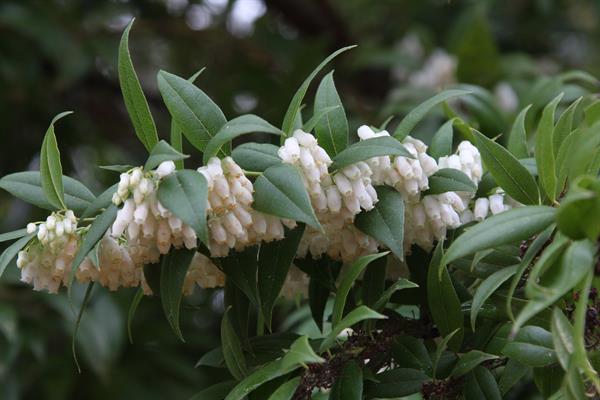
Comments: This underutilized medium-sized shrub, native to wet hummocks and woodlands from SC to FL, deserves a place in your yard! The attractive arching, loosely rounded form, and evergreen foliage of Florida-hobblebush, is further enhanced in early summer by numerous tiny honey-fragrant white flowers. Displaying moderate drought tolerance once established, Florida-hobblebush grows well in our area, in woodland gardens and as an informal screen. This species responds well to pruning and can be maintained as a hedge.
Height: 6-15 ft.
plant sale text: This underutilized medium-sized shrub, native to wet hummocks and woodlands from SC to FL, deserves a place in your yard! The attractive arching, loosely rounded form, and evergreen foliage of Florida-hobblebush, is further enhanced in early summer by numerous tiny honey-fragrant white flowers. Displaying moderate drought tolerance once established, Florida-hobblebush grows well in our area, in woodland gardens and as an informal screen. This species responds well to pruning and can be maintained as a hedge.
bloom table text: Florida-hobblebush or Florida leucothoe is a broadleaf evergreen, 8-12 ft. high, with a lax, arching, multi-stemmed habit. Its rich, glossy-green foliage, tinged with red on new growth is evergreen through the winter. Though natively occurring nearer the coast, this is an excellent landscape plant. It offers wonderful screen potential, but it is the cream-colored, honey fragrant flowers borne in profuse axillary clusters that is its true charm. This species responds well to pruning and can be maintained as a hedge.
description:
stems:
leaves:
inflorescence:
flowers:
fruits:
comments: This underutilized medium-sized shrub, native to wet hummocks and woodlands from SC to FL, deserves a place in your yard! The attractive arching, loosely rounded form, and evergreen foliage of Florida-hobblebush, is further enhanced in early summer by numerous tiny honey-fragrant white flowers. Displaying moderate drought tolerance once established, Florida-hobblebush grows well in our area, in woodland gardens and as an informal screen. This species responds well to pruning and can be maintained as a hedge.
cultural notes:
germination code: 1, 4
native range: (NC ?), SC, GA & FL
0 unsaved edits on this page.