Copy permalink to share
Apocynaceae
Asclepias

not marked as a favorite taxon Asclepias syriaca Linnaeus. Common name: Common Milkweed. Phenology: Jun-Aug; Jul-Sep. Habitat: Prairies, floodplains, pastures, roadsides, disturbed areas. Distribution: NB and ME west to s. MB and ND, south to SC, GA, c. TN (Chester, Wofford, & Kral 1997), AR, OK, and KS, the southern range expansion recent. This species is apparently expanding its range southward; see Wyatt et al. (1993) and Wyatt (1996) for discussion.

Glossary (beta!)

Origin/Endemic status: Native

Synonymy : = Ar, C, Can, FNA14, GrPl, K4, Mi, Mo2, NE, NY, Ok, Pa, RAB, S, Tat, Tn, Va, W, Woodson (1954); > Asclepias syriaca L. var. kansana (Vail) Palmer & Steyerm. — F, G, Il; > Asclepias syriaca L. var. syriaca — F, G, Il. Basionym: Asclepias syriaca L. 1753

Links to other floras: = Asclepias syriaca - FNA14

Show in key(s)

Show parent genus | Show parent in key(s)

Wetland Indicator Status:

  • Atlantic and Gulf Coastal Plain: UPL
  • Eastern Mountains and Piedmont: FACU
  • Great Plains: UPL
  • Midwest: FACU
  • Northcentral & Northeast: UPL

Heliophily : 8

Your browser does not support SVGs

Hover over a shape, letter, icon, or arrow on the map for definition or see the legend.
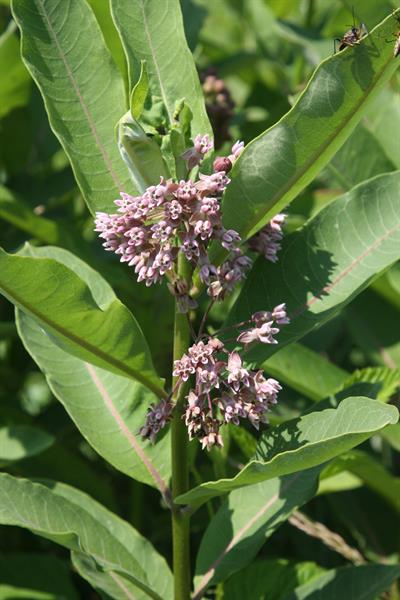
image #1 of Asclepias syriaca© Keith Bradley | Original Image ⭷
image #2 of Asclepias syriaca© Alan M. Cressler | Original Image ⭷
image #3 of Asclepias syriaca© Scott Allen Davis, some rights reserved (CC BY), uploaded by Scott Allen Davis source CC-BY | Original Image ⭷
image #5 of Asclepias syriaca© Collectors SOS | Original Image ⭷
image #6 of Asclepias syriaca© Grant Morrow Parkins | Original Image ⭷
image #7 of Asclepias syriaca© Scott Ward | Original Image ⭷
image #8 of Asclepias syriaca© evangrimes, some rights reserved (CC BY), uploaded by evangrimes source CC-BY | Original Image ⭷
image #9 of Asclepias syriaca© Bennett Grappone, some rights reserved (CC BY), uploaded by Bennett Grappone source CC-BY | Original Image ⭷
image #10 of Asclepias syriaca© Liren Varghese, some rights reserved (CC BY), uploaded by Liren Varghese source CC-BY | Original Image ⭷
image #11 of Asclepias syriaca© Sandy Wolkenberg, some rights reserved (CC BY), uploaded by Sandy Wolkenberg source CC-BY | Original Image ⭷
image #12 of Asclepias syriaca© Bruce A. Sorrie | Original Image ⭷
image #13 of Asclepias syriaca© Bruce A. Sorrie | Original Image ⭷
image #14 of Asclepias syriaca© Michael Newlon, some rights reserved (CC BY), uploaded by Michael Newlon source CC-BY | Original Image ⭷
image #15 of Asclepias syriaca© Keith Bradley | Original Image ⭷
image #16 of Asclepias syriaca© Alan M. Cressler | Original Image ⭷
image #17 of Asclepias syriaca© Erik Danielson source | Original Image ⭷
image #18 of Asclepias syriaca© Collectors SOS | Original Image ⭷
image #19 of Asclepias syriaca© Scott Ward | Original Image ⭷
image #20 of Asclepias syriaca© Bruce A. Sorrie | Original Image ⭷

Feedback

See something missing or incorrect about Asclepias syriaca? Let us know here:
  1. Please include your name and if possible, email in case when need to clarify what you wrote.
  2. If you opt out of including email, please be as specific as possible (e.g., which photo is incorrect?)
  3. Please do not submit questions asking to identify plants or about horticultural topics (e.g., how do I control an invasive plant in my garden?). Instead, those questions can be submitted here for the Carolinas region only.
  4. Please do not send us feedback about unkeyed species as this work is ongoing.
  5. Please allow time for flora edits to show in our next data release. We greatly appreciate your feedback but may require extra time to research complicated taxonomic issues.

Horticultural Information

NCBG trait

Intro: A conspicuous, coarse perennial that forms large colonies in unmowed fields, pastures, roadsides and other disturbed areas.

Stems: Stem stout, unbranched, often furry; leaks milky sap when bruised.

Leaves: Leaves opposite, short-petiolate, oval to oblong, 6-9 in. long, with a reddish central vein, soft-hairy beneath.

Inforescence:

Flowers: Flowers on long stalks that often droop, in a globe-shaped terminal umbel and a few upper axillary umbels; fragrant, pale-purple to rose-colored, with 5 strongly reflexed corolla lobes and a central crown--composed of 5 2-parted appendages ("hood" and "horn")--surrounding a complex structure of fused anthers and style.

Fruits: Fruit a warty, somewhat furry, oval follicle containing tufted seeds.

Comments: This species, a well-known Monarch host plant, is apparently expanding its range southward.

Height: 3-6 ft.

plant sale text: Common milkweed is the most substantial of our native milkweeds. It is a great host plant for monarch larvae and a nectar source for adult butterflies. It is also showy, both in flower and in fruit. Large round clusters of dusty pink flowers are followed by large warty pods trailing delicate milkweed fluff. It is drought tolerant, and works well in a loose or wild landscape like a meadow or woodland edge. Individual plants are large and are likely to form colonies. Milkweeds support up to 12 species of lepidoptera.

bloom table text:

description: A conspicuous, coarse perennial that forms large colonies in unmowed fields, pastures, roadsides and other disturbed areas.

stems: Stem stout, unbranched, often furry; leaks milky sap when bruised.

leaves: Leaves opposite, short-petiolate, oval to oblong, 6-9 in. long, with a reddish central vein, soft-hairy beneath.

inflorescence:

flowers: Flowers on long stalks that often droop, in a globe-shaped terminal umbel and a few upper axillary umbels; fragrant, pale-purple to rose-colored, with 5 strongly reflexed corolla lobes and a central crown--composed of 5 2-parted appendages ("hood" and "horn")--surrounding a complex structure of fused anthers and style.

fruits: Fruit a warty, somewhat furry, oval follicle containing tufted seeds.

comments: This species, a well-known Monarch host plant, is apparently expanding its range southward.

cultural notes:

germination code: 2

native range: eastern North America


0 unsaved edits on this page.