 Argyrochosma (J. Smith) Windham. Powdery Cloak Fern.
A genus of about 30 species, of s. North America, Central America, South America, and the West Indies. Traditionally treated as a component of Notholaena (or sometimes Pellaea) (Tryon, Tryon, & Kramer in Kramer & Green 1990), but best recognized as a separate genus (Windham in FNA 1993b, Windham 1987, Gastony & Rollo 1998). Molecular studies show that this group is more closely related to Pellaea and Astrolepis than to Notholaena.
ID notes:Argyrochosma has highly compound leaves (3-5-pinnate) with tiny ultimate segments (these < 4 mm wide) that may or may not have a dense covering of farina (waxy powder) on the lower surface. Our species occur on or associated with calcareous rock outcrops.
Ref: Gastony & Rollo (1998); Kramer & Green (1990); Sigel et al. (2011); Tryon, Tryon, & Kramer In Kramer & Green (1990); Windham (1987); Windham (1993b) In Flora of North America Editorial Committee (1993b). Show full citations.
Hover over a shape, letter, icon, or arrow on the map for definition or see the legend. Data for arrows not developed for genera and families which may have species only occurring outside the flora area.
 © Brad Von Blon, some rights reserved (CC BY), uploaded by Brad Von Blon | Argyrochosma dealbata source | Original Image ⭷
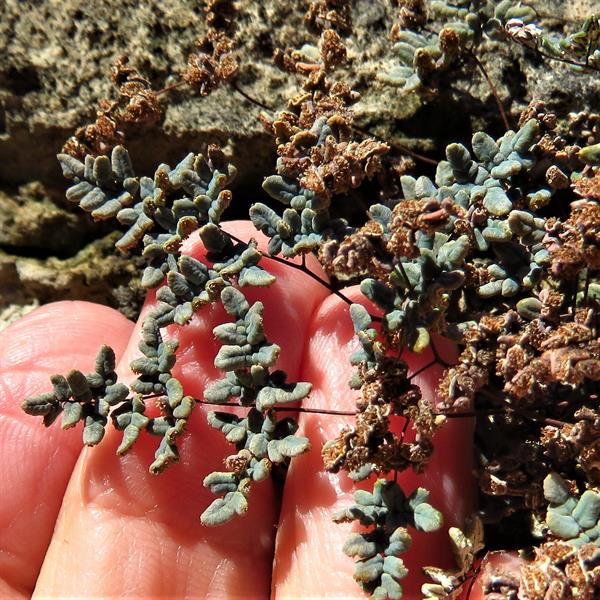 © Annika Lindqvist, some rights reserved (CC BY), uploaded by Annika Lindqvist | Argyrochosma dealbata source | Original Image ⭷
 © Michelle, some rights reserved (CC BY), uploaded by Michelle | Argyrochosma dealbata source | Original Image ⭷
Feedback
See something wrong or missing on about Argyrochosma? Let us know here: (Please include your name and email if at all complicated so we can clarify if needed.)
Cite as...