 Dioscorea Linnaeus. Yam.
A genus of about 575-850 species, vines, of tropical and warm temperate regions of the Old World and New World. Huber in Kubitzki (1998a) advocates the division of the large and unwieldy Dioscorea into separate genera. Dioscorea (broadly defined) has a wide variety of economic uses, especially in the tropics, where it is most diverse. Various species are cultivated for their edible tubers (yams, not to be mistaken for sweet potatoes, Ipomoea batatas, which are often referred to colloquially as ‘yams’ in the southern United States), especially in Africa. Oral contraceptives were developed from extracts of Dioscorea. Many other uses are described in Al-Shehbaz & Schubert (1989).
ID notes:Smilax section Nemexia are sometimes confused with our native Dioscorea (key lead 1a) because of a superficial similarity. They can be readily distinguished even in vegetative condition by Smilax section Nemexia having 3 (-5) main veins, the 3 central rejoining at the leaf apex (vs. Dioscorea with 7-13 main veins), and secondary veins in a complex reticulate pattern (vs. Dioscorea with secondary veins forming simpler and largely perpendicular cross-connections between the primary veins).
Ref: Al-Shehbaz & Schubert (1989); Huber In Kubitzki (1998a); Kubitzki (1998a); Raz (2002) In Flora of North America Editorial Committee (2002a); Ward (1977c). Show full citations.
Hover over a shape, letter, icon, or arrow on the map for definition or see the legend. Data for arrows not developed for genera and families which may have species only occurring outside the flora area.
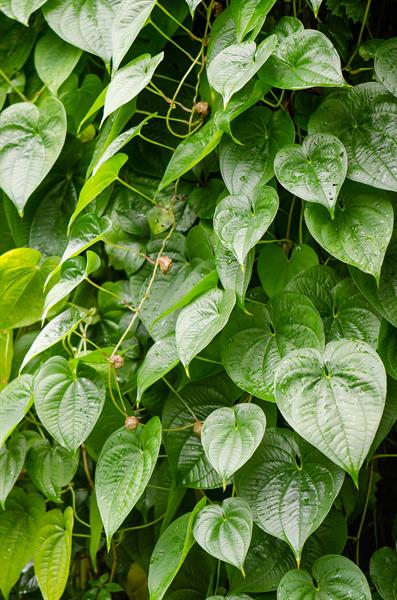 © Keith Bradley | Dioscorea bulbifera | Original Image ⭷
 © Alan M. Cressler | Dioscorea villosa | Original Image ⭷
 © Edwin Bridges | Dioscorea villosa | Original Image ⭷
Feedback
See something wrong or missing on about Dioscorea? Let us know here: (Please include your name and email if at all complicated so we can clarify if needed.)
Cite as...