Copy permalink to share

Symphyotrichum prenanthoides (Muhlenberg ex Willdenow) Nesom. Common name: Zigzag Aster. Phenology: Late Aug-Oct. Habitat: Moist or wet forests, roadbanks, fields. Distribution: MA, NY, s. ON, and MN, south to w. NC, TN, IL, and IA.

Origin/Endemic status: Native

Synonymy : = FNA20, Il, K4, NE, NY, Pa, Tn, Va, Nesom (1994a); = Aster prenanthoides Muhl. ex Willd. — C, F, G, Oh3, RAB, S, SE1, Tat, W, WV. Basionym: Aster prenanthoides Muhl. ex Willd. 1803

Links to other floras: = Symphyotrichum prenanthoides - FNA20

Show in key(s)

Show parent genus | Show parent in key(s)

Wetland Indicator Status:

  • Atlantic and Gulf Coastal Plain: FAC
  • Eastern Mountains and Piedmont: FAC
  • Midwest: FAC
  • Northcentral & Northeast: FAC

Heliophily : 5

Your browser does not support SVGs

Hover over a shape, letter, icon, or arrow on the map for definition or see the legend.
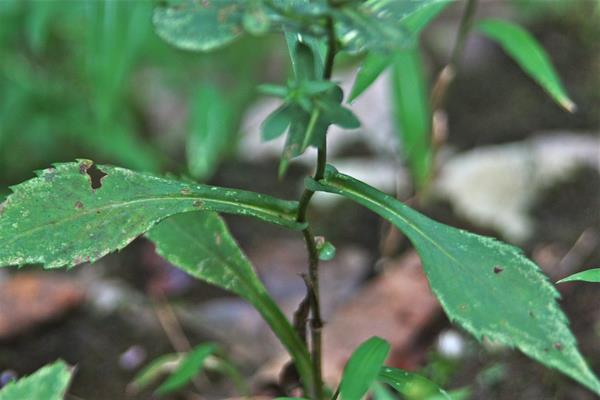
image of plant© Erik Danielson source | Original Image ⭷
image of plant© Jim Brighton | Original Image ⭷
image of plant© Gary P. Fleming
image of plant© Tom Potterfield | Original Image ⭷
image of plant© Joey Shaw source | Original Image ⭷
image of plant© Tom Potterfield | Original Image ⭷
image of plant© Jim Brighton | Original Image ⭷

Feedback

See something missing or incorrect about Symphyotrichum prenanthoides? Let us know here:

  1. Please include your name and if possible, email in case when need to clarify what you wrote.
  2. If you opt out of including email, please be as specific as possible (e.g., which photo is incorrect?)
  3. Please do not submit questions asking to identify plants or about horticultural topics (e.g., how do I control an invasive plant in my garden?). Instead, those questions can be submitted here for the Carolinas region only.
  4. Please do not send us feedback about unkeyed species as this work is ongoing.
  5. Please allow time for flora edits to show in our next data release. We greatly appreciate your feedback but may require extra time to research complicated taxonomic issues.

Horticultural Information

NCBG trait

Intro: Erect, rhizomatous and colonial perennial found in mesic upland forests, floodplain forests and road banks.

Stems: Stems slightly zigzagged between nodes, with 15-30 nodes below the inflorescence, smooth below and finely hairy above.

Leaves: Leaves alternate, winged-petiolate and clasping, lance-shaped, 2 1/2-6 in. long, sharply toothed in the middle, rough to smooth above and smooth or loosely hairy along the mid-rib beneath.

Inforescence:

Flowers: Composite flowers (heads) in a leafy-bracted terminal panicle; heads 1-1 1/2 in. wide, consisting of 20-35 pale blue or violet (rarely white), narrow ray florets encircling a center disk of yellow tubular florets. Several whorls of sharp-tipped, narrowly linear green bracts surround the bell-shaped base of each head, their tips recurved-spreading.

Fruits: Fruit a yellow-tufted achene.

Comments:

Height: 1-4 ft.

plant sale text:

bloom table text:

description: Erect, rhizomatous and colonial perennial found in mesic upland forests, floodplain forests and road banks.

stems: Stems slightly zigzagged between nodes, with 15-30 nodes below the inflorescence, smooth below and finely hairy above.

leaves: Leaves alternate, winged-petiolate and clasping, lance-shaped, 2 1/2-6 in. long, sharply toothed in the middle, rough to smooth above and smooth or loosely hairy along the mid-rib beneath.

inflorescence:

flowers: Composite flowers (heads) in a leafy-bracted terminal panicle; heads 1-1 1/2 in. wide, consisting of 20-35 pale blue or violet (rarely white), narrow ray florets encircling a center disk of yellow tubular florets. Several whorls of sharp-tipped, narrowly linear green bracts surround the bell-shaped base of each head, their tips recurved-spreading.

fruits: Fruit a yellow-tufted achene.

comments:

cultural notes:

germination code:

native range:


0 unsaved edits on this page.