 Setaria Palisot de Beauvois. Subfamily: Panicoideae. Tribe: Paniceae. Subtribe: Cenchrinae. supertribe: Panicodae. clade: "PACMAD". Foxtail Grass.
A genus of about 110-140 species, of tropical and warm temperate regions. Webster (1995) merged Paspalidium into Setaria, but it now appears that Paspalidium should be held as separate.
Ref: Allen (2003a) In Flora of North America Editorial Committee (2003a); Crins (1991); Rominger (2003) In Flora of North America Editorial Committee (2003a); Webster (1988); Webster (1993b); Webster (1995). Show full citations.
Hover over a shape, letter, icon, or arrow on the map for definition or see the legend. Data for arrows not developed for genera and families which may have species only occurring outside the flora area.
 © Gary P. Fleming | Setaria faberi | Original Image ⭷
 © Keith Bradley | Setaria barbata | Original Image ⭷
 © Bruce A. Sorrie | Setaria faberi | Original Image ⭷
 © Gary P. Fleming | Setaria italica | Original Image ⭷
 © Gary P. Fleming | Setaria faberi | Original Image ⭷
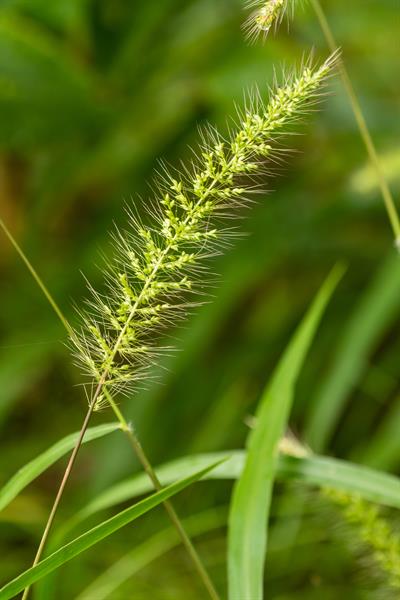 © Keith Bradley | Setaria macrosperma | Original Image ⭷
Feedback
See something wrong or missing on about Setaria? Let us know here: (Please include your name and email if at all complicated so we can clarify if needed.)
Cite as...