 Thyrsanthella (Baillon) Pichon. Subfamily: Apocynoideae. Climbing Dogbane.
A monotypic genus, a liana, of se. North America (Endress et al. 2018). This species has been traditionally treated as the only North American taxon of Trachelospermum, an otherwise se. Asian genus of about 15-20 species. Such a treatment is untenable, however, as morphological and molecular evidence clearly show that our native taxon is only distantly related to Asian Trachelospermum (Livshultz et al. 2007); it is most closely related to the small genus Pinochia M.E. Endress & B.F. Hansen, of the Greater Antilles, Mexico, and Central America (Endress & Hansen 2007).
ID notes:Sterile Thyrsanthella difformis is sometimes mistaken at a glance for Gelsemium (both woody vines with opposite lanceolate leaves), but in the field the milky sap of Thyrsanthella provides an immediate identifying characteristic.
Ref: Endress & Hansen (2007); Endress et al. (2018) In Kadereit & Bittrich (2018); Lemke (2023r) In Flora of North America Editorial Committee (2023c); Livshultz et al. (2007). Show full citations.
Hover over a shape, letter, icon, or arrow on the map for definition or see the legend. Data for arrows not developed for genera and families which may have species only occurring outside the flora area.
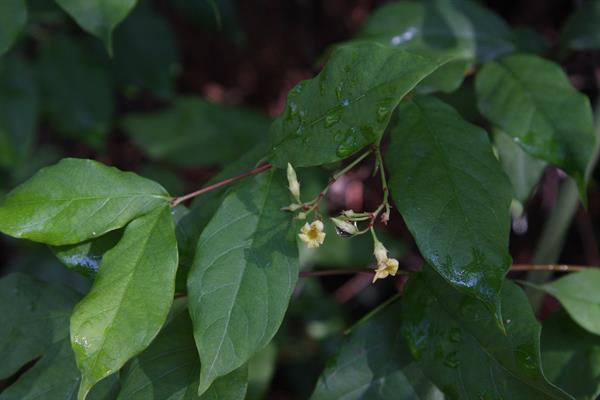 © Bruce A. Sorrie | Thyrsanthella difformis | Original Image ⭷
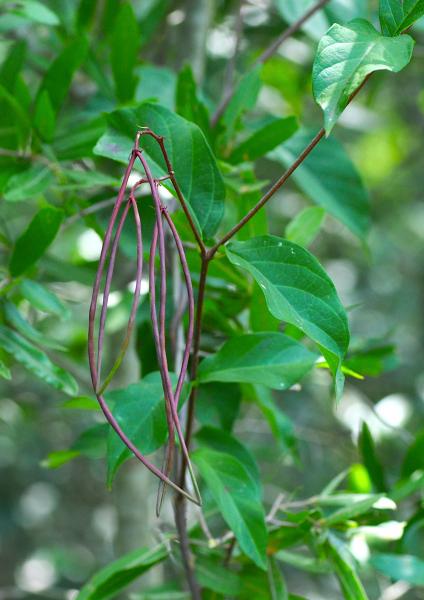 © Sonnia Hill | Thyrsanthella difformis | Original Image ⭷
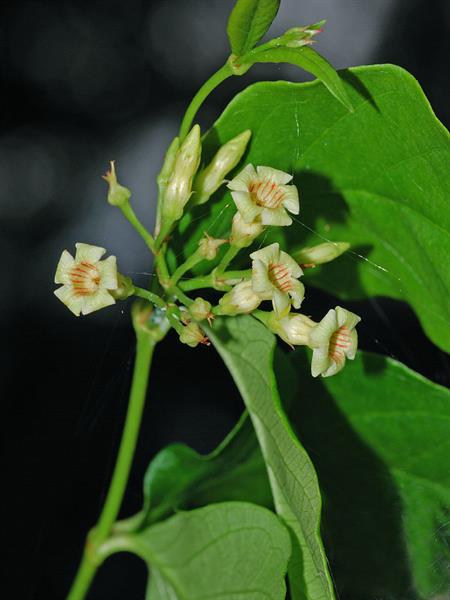 © Gary P. Fleming | Thyrsanthella difformis | Original Image ⭷
Feedback
See something wrong or missing on about Thyrsanthella? Let us know here: (Please include your name and email if at all complicated so we can clarify if needed.)
Cite as...