 Berberidaceae A.L. de Jussieu. Barberry Family.
As broadly defined here, a family of about 17 genera and 650 species, herbs and shrubs, of the temperate Northern Hemisphere and Andean South America. The Berberidaceae seemed heterogeneous to many in the 1970s through 1990s and was often split into multiple families, such as Podophyllaceae, Epimediaceae, Nandinaceae, and Leonticaceae. More recently and based on molecular studies, Kim & Jansen (1996, 1998) and Kim et al. (2004) concluded that division of the Berberidaceae into segregate families was not warranted, a conclusion now universally accepted.
Ref: Ahrendt (1961); Kim & Jansen (1996); Kim & Jansen (1998); Kim et al. (2004); Loconte & Estes (1989b); Loconte In Kubitzki, Rohwer, & Bittrich (1993); Meacham (1980); Stearn (2002); Wang et al. (2009); Whetstone, Atkinson, & Spaulding (1997) In Flora of North America Editorial Committee (1997); Yu & Chung (2017). Show full citations.
Hover over a shape, letter, icon, or arrow on the map for definition or see the legend. Data for arrows not developed for genera and families which may have species only occurring outside the flora area.
 © Scott Ward | Jeffersonia | Original Image ⭷
 © Will Stuart | Diphylleia cymosa | Original Image ⭷
 © Alan M. Cressler | Caulophyllum thalictroides | Original Image ⭷
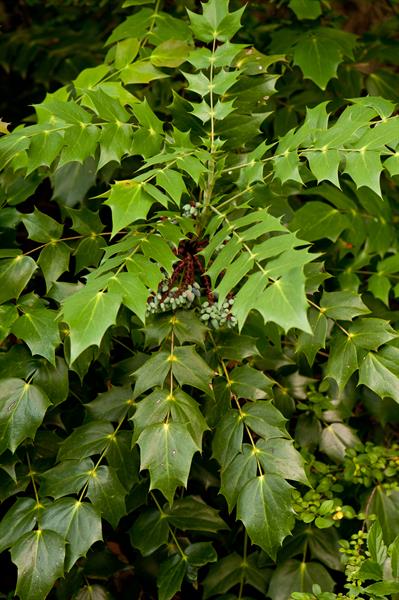 © Keith Bradley | Mahonia bealei | Original Image ⭷
 © Gary P. Fleming | Berberis thunbergii | Original Image ⭷
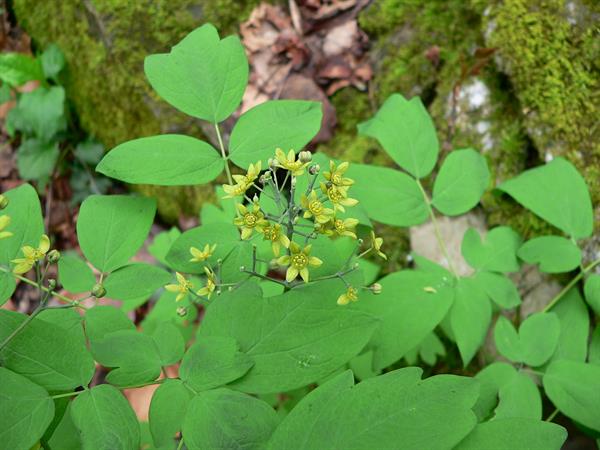 © Richard & Teresa Ware | Caulophyllum CC-BY-NC, permission granted to NCBG | Original Image ⭷
 © Scott Ward | Jeffersonia diphylla | Original Image ⭷
 © Keith Bradley | Nandina domestica | Original Image ⭷
 © Keith Bradley | Podophyllum peltatum | Original Image ⭷
Feedback
See something wrong or missing on about Berberidaceae? Let us know here: (Please include your name and email if at all complicated so we can clarify if needed.)
Cite as...