 Geocarpon Mackenzie.
A genus of 7 species, annual and perennial herbs, centered in eastern North America. See Schilling et al. (2022) for detailed information.
Ref: Buthod & Miller (2023); Maguire (1951); Nienaber (2005) In Flora of North America Editorial Committee (2005); Rabeler, Hartman, & Utech (2005) In Flora of North America Editorial Committee (2005); Schilling et al. (2022). Show full citations.
Hover over a shape, letter, icon, or arrow on the map for definition or see the legend. Data for arrows not developed for genera and families which may have species only occurring outside the flora area.
 © Gary P. Fleming | Geocarpon glabrum | Original Image ⭷
 © Alan Cressler: Minuartia groenlandica, with Frankliniella tritici, Grassy Ridge Bald, Pisgah National Forest, Mitchell County, North Carolina 1 by Alan Cressler | Geocarpon groenlandicum source | Original Image ⭷
 © Gary P. Fleming | Geocarpon groenlandicum | Original Image ⭷
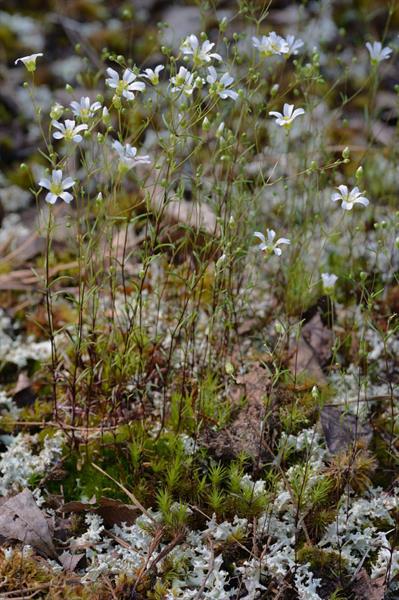
 © Alan Cressler: Mononeuria uniflora, Lithonia Gneiss Flat Rock, Arabia Mountain National Heritage Area, DeKalb County, Georgia 1 by Alan Cressler | Geocarpon uniflorum source | Original Image ⭷
Feedback
See something wrong or missing on about Geocarpon? Let us know here: (Please include your name and email if at all complicated so we can clarify if needed.)
Cite as...