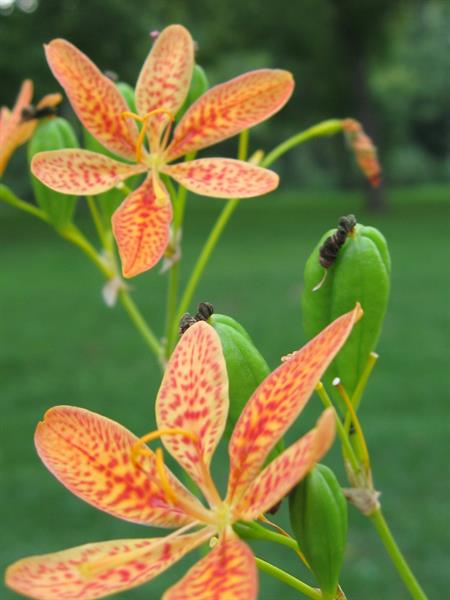
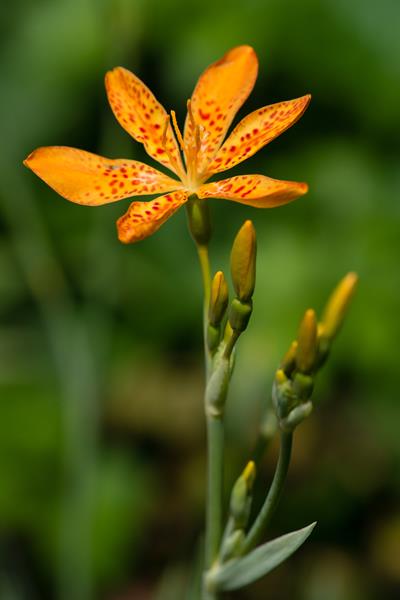
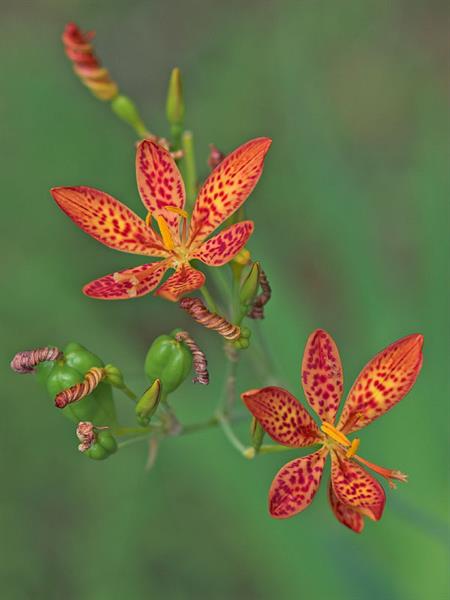
*Iris domestica (Linnaeus) Goldblatt & Mabberley. Common name: Blackberry-lily, Leopard-lily. Phenology: May-Aug; Aug-Nov. Habitat: Dry woodlands, forests, edges of granitic flatrocks, cedar glades, old homesites, suburban areas. Distribution: Native of e. Asia.
Origin/Endemic status: E. and se. Asia
Synonymy ⓘ: = Ar, K4, Mi, NE, NY, POWO, Tn, Va, WH3, Goldblatt & Mabberley (2005); Epidendrum domesticum L. = Belamcanda chinensis (L.) Medik. — C, ETx1, F, FNA26, G, Il, Mo1, NS, Pa, RAB, S, Tat, Tx, W, WV; = Gemmingia chinensis (L.) Kuntze — S13. Basionym: Epidendrum domesticum L. 1753
Links to other floras: = Belamcanda chinensis - FNA26
Show parent genus | Show parent in key(s)
Heliophily ⓘ: 7
Hover over a shape, letter, icon, or arrow on the map for definition or see the legend.
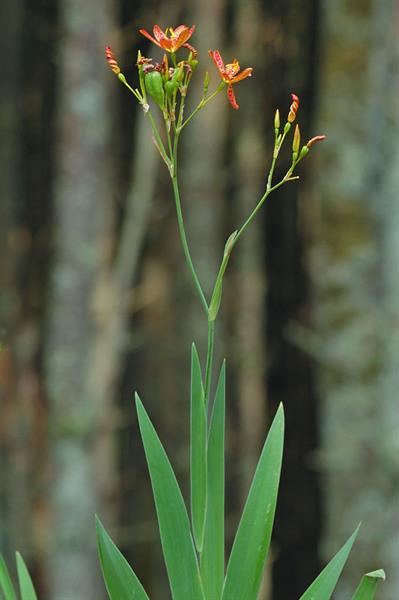
© Gary P. Fleming | Original Image ⭷
© Keith Bradley | Original Image ⭷
© Paul Marcum source | Original Image ⭷
© Keith Bradley | Original Image ⭷
© Gary P. Fleming | Original Image ⭷Feedback
See something missing or incorrect about Iris domestica? Let us know here:
- Please include your name and if possible, email in case when need to clarify what you wrote.
- If you opt out of including email, please be as specific as possible (e.g., which photo is incorrect?)
- Please do not submit questions asking to identify plants or about horticultural topics (e.g., how do I control an invasive plant in my garden?). Instead, those questions can be submitted here for the Carolinas region only.
- Please do not send us feedback about unkeyed species as this work is ongoing.
- Please allow time for flora edits to show in our next data release. We greatly appreciate your feedback but may require extra time to research complicated taxonomic issues.
Horticultural Information
Intro: Erect-ascending, rhizomatous perennial found in dry woodlands, forests, edges of granitic flatrocks and suburban areas. Native of e. Asia.
Stems: Stems with 3-5 short branches near top.
Leaves: Leaves mostly basal, overlapping and with clasping bases, 1-2 ft. long, in a fan-shaped arrangement (smaller bract-like leaves widely scattered on flowering scape); with white-waxy coating.
Inforescence:
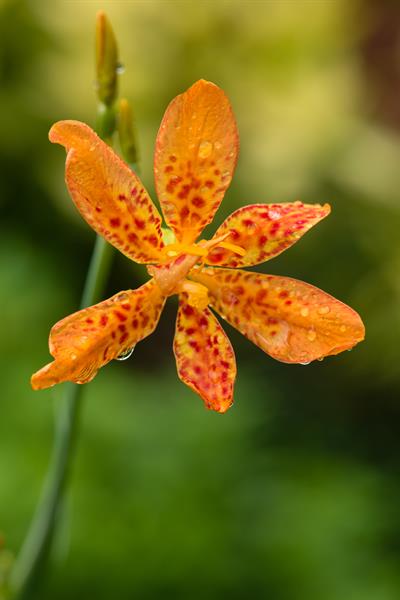
Flowers: Flowers at top of scape in groups of 3-6, each group originating from a modified leaf (spathe) about 1/2 in. long; orange to orange-yellow mottled with red or purple; to 2 in. wide; consisting of 6 elliptic to oblong tepals that spread from the top of a green ovary.
Fruits: Fruit an oval capsule, which splits to reveal a cluster of shiny black seeds resembling a blackberry.
Comments:
Height: 1-3 ft.
plant sale text:
bloom table text:
description: Erect-ascending, rhizomatous perennial found in dry woodlands, forests, edges of granitic flatrocks and suburban areas. Native of e. Asia.
stems: Stems with 3-5 short branches near top.
leaves: Leaves mostly basal, overlapping and with clasping bases, 1-2 ft. long, in a fan-shaped arrangement (smaller bract-like leaves widely scattered on flowering scape); with white-waxy coating.
inflorescence:
flowers: Flowers at top of scape in groups of 3-6, each group originating from a modified leaf (spathe) about 1/2 in. long; orange to orange-yellow mottled with red or purple; to 2 in. wide; consisting of 6 elliptic to oblong tepals that spread from the top of a green ovary.
fruits: Fruit an oval capsule, which splits to reveal a cluster of shiny black seeds resembling a blackberry.
comments:
cultural notes:
germination code:
native range: central Asia, India & China
0 unsaved edits on this page.