Camassia scilloides (Rafinesque) Cory. Common name: Wild Hyacinth, Quamash Lily, Eastern Camas Lily. Phenology: Mar-May (-Jun). Habitat: Circumneutral prairies, oak savannas, calcareous glades, woodlands, and forests; eastwards relictual and scattered in circumneutral soils, in GA, VA, and WV on limestone, in NC on slopes and natural levees in rich alluvium along the Roanoke River, in SC over gabbro. Distribution: W. PA and s. ON west to s. WI and e. KS, south to nw. GA (Jones & Coile 1988) and TX, nearly entirely west of the Blue Ridge, with only a few disjunct occurrences in the Piedmont and Coastal Plain.
Origin/Endemic status: Native
Other Comments: The bulb is edible and was an important food source for indigenous Americans and early settlers; however, it resembles that of the potentially fatal Toxicoscordion nuttallii (Diggs et al. 2006).
Synonymy ⓘ: = Ar, C, Can, F, FNA26, G, Il, K4, Mi, Mo1, NcTx, NS, Ok, Pa, POWO, RAB, Va, W; = n/a — Tat; < Camassia scilloides (Raf.) Cory — ETx1, Tx; < Quamasia hyacintha (Raf.) Britton — S, S13. Basionym: Cyanotris scilloides Raf. 1818
Links to other floras: = Camassia scilloides - FNA26
Show parent genus | Show parent in key(s)
Wetland Indicator Status:
- Atlantic and Gulf Coastal Plain: FACW (taxonomic split from wetland indicator species)
- Eastern Mountains and Piedmont: FAC (taxonomic split from wetland indicator species)
- Great Plains: FAC (taxonomic split from wetland indicator species)
- Midwest: FAC (taxonomic split from wetland indicator species)
- Northcentral & Northeast: FAC (taxonomic split from wetland indicator species)
Heliophily ⓘ: 5
Hover over a shape, letter, icon, or arrow on the map for definition or see the legend.
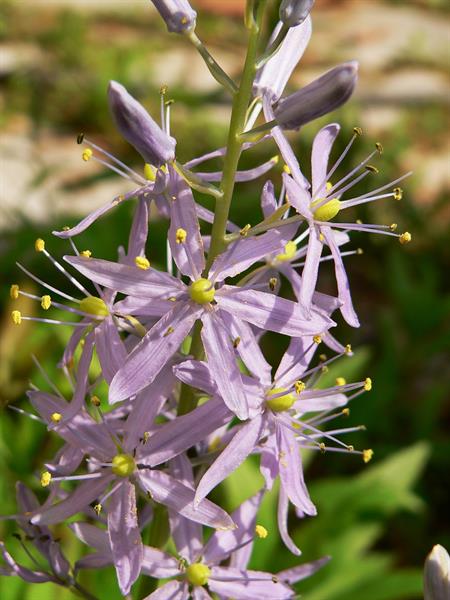
© Richard & Teresa Ware CC-BY-NC, permission granted to NCBG | Original Image ⭷
no rights reserved, uploaded by Dawn VanDeman source CC0 | Original Image ⭷
© Sonnia Hill | Original Image ⭷
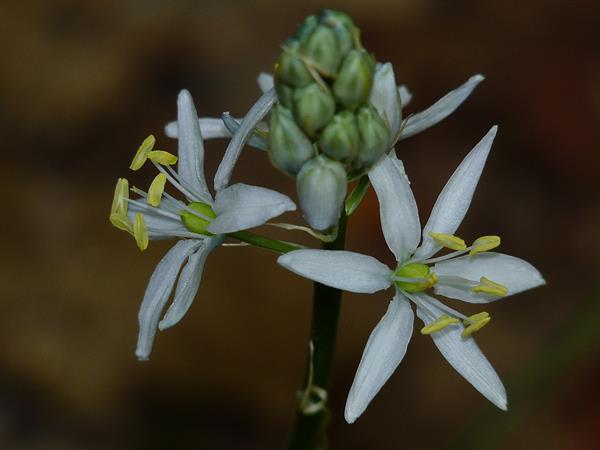
© Nathan Aaron, some rights reserved (CC BY), uploaded by Nathan Aaron source CC-BY | Original Image ⭷
© Laura Gaudette, some rights reserved (CC BY), uploaded by Laura Gaudette source CC-BY | Original Image ⭷
© Richard & Teresa Ware CC-BY-NC, permission granted to NCBG | Original Image ⭷
© Ghostomelon, some rights reserved (CC BY), uploaded by Ghostomelon source CC-BY | Original Image ⭷
no rights reserved, uploaded by Terri Koontz source CC0 | Original Image ⭷
© Cindy, some rights reserved (CC BY), uploaded by Cindy source CC-BY | Original Image ⭷Feedback
See something missing or incorrect about Camassia scilloides? Let us know here:
- Please include your name and if possible, email in case when need to clarify what you wrote.
- If you opt out of including email, please be as specific as possible (e.g., which photo is incorrect?)
- Please do not submit questions asking to identify plants or about horticultural topics (e.g., how do I control an invasive plant in my garden?). Instead, those questions can be submitted here for the Carolinas region only.
- Please do not send us feedback about unkeyed species as this work is ongoing.
- Please allow time for flora edits to show in our next data release. We greatly appreciate your feedback but may require extra time to research complicated taxonomic issues.
Horticultural Information
Intro: Scapose perennial from a bulb, growing in moist, open forests and sometimes on slopes and natural levees, usually over circumneutral soils.
Stems: Stem a mostly naked flowering stalk; there may be 1 or 2 reduced leaves near the top.
Leaves: Leaves in a basal clump, strap-like, 10-18 in. long.
Inforescence:
Flowers: Flowers in a terminal raceme 5-7 in. long, light lavender to blue, to 1 in. wide, consisting of 6 linear-elliptic tepals with 3 veins, 6 prominent yellow stamens and a green ovary with style.
Fruits: Fruit a 3-sectioned, round capsule containing shiny black seeds.
Comments: Native Americans and early settlers used the bulbs of this plant for food.
Height: 1-2 ft.
plant sale text:
bloom table text:
description: Scapose perennial from a bulb, growing in moist, open forests and sometimes on slopes and natural levees, usually over circumneutral soils.
stems: Stem a mostly naked flowering stalk; there may be 1 or 2 reduced leaves near the top.
leaves: Leaves in a basal clump, strap-like, 10-18 in. long.
inflorescence:
flowers: Flowers in a terminal raceme 5-7 in. long, light lavender to blue, to 1 in. wide, consisting of 6 linear-elliptic tepals with 3 veins, 6 prominent yellow stamens and a green ovary with style.
fruits: Fruit a 3-sectioned, round capsule containing shiny black seeds.
comments: Native Americans and early settlers used the bulbs of this plant for food.
cultural notes:
germination code:
native range: eastern North America
0 unsaved edits on this page.