Copy permalink to share
Asteraceae
Eupatorium

not marked as a favorite taxon Eupatorium glaucescens Elliott. Common name: Wedgeleaf Eupatorium, Broadleaf Bushy Eupatorium. Phenology: Late Jul-Oct. Habitat: Longleaf pine sandhills, dry sandy woodlands. Distribution: Widespread in the Southeastern Coastal Plain, ranging from se. VA south to FL and west to MS and e. TX.

Glossary (beta!)

Origin/Endemic status: Endemic

Taxonomy Comments: The name E. cuneifolium must be rejected on nomenclatural grounds (Gandhi & Thomas 1991).

Synonymy : = Eupatorium cuneifolium Willd. — S; = Eupatorium cuneifolium Willd. var. cuneifolium — F; < Eupatorium cuneifolium Willd. — C, G, RAB, SE1; < Eupatorium glaucescens Elliott — Tx; < Eupatorium linearifolium Walter — Fl7, FNA21, K4, WH3; Eupatorium glaucescens Elliott. Basionym: Eupatorium glaucescens Elliott 1824 [1823]

Links to other floras: < Eupatorium linearifolium - FNA21

Show in key(s)

Show parent genus | Show parent in key(s)

Heliophily : 9

Your browser does not support SVGs

Hover over a shape, letter, icon, or arrow on the map for definition or see the legend.
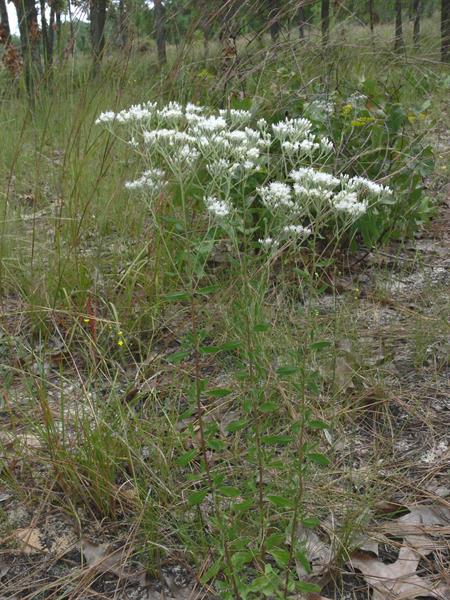
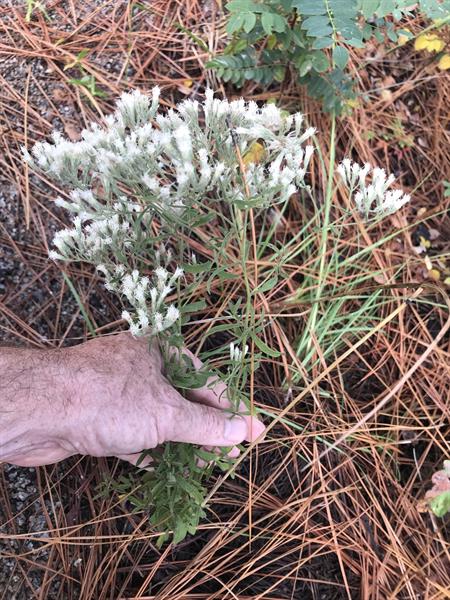
image #1 of Eupatorium glaucescens© Bruce A. Sorrie | Original Image ⭷
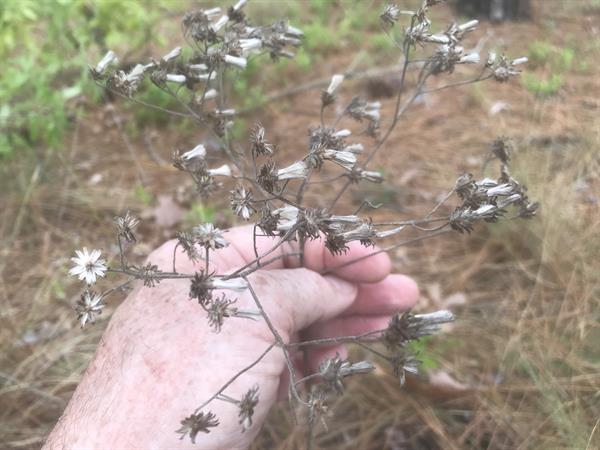
image #2 of Eupatorium glaucescens© Scott Ward | Original Image ⭷
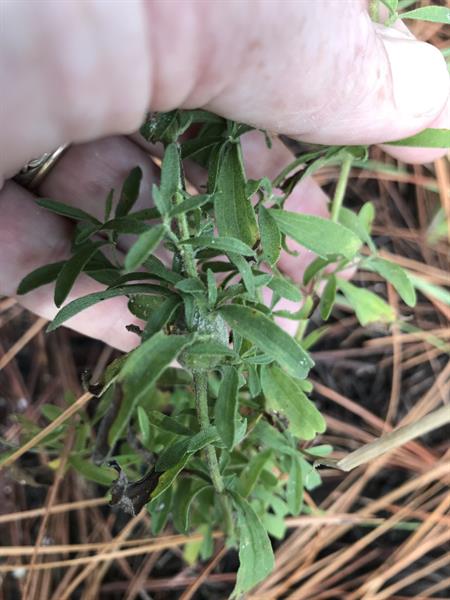
image #3 of Eupatorium glaucescens© Scott Ward, some rights reserved (CC BY), uploaded by Scott Ward source CC-BY | Original Image ⭷
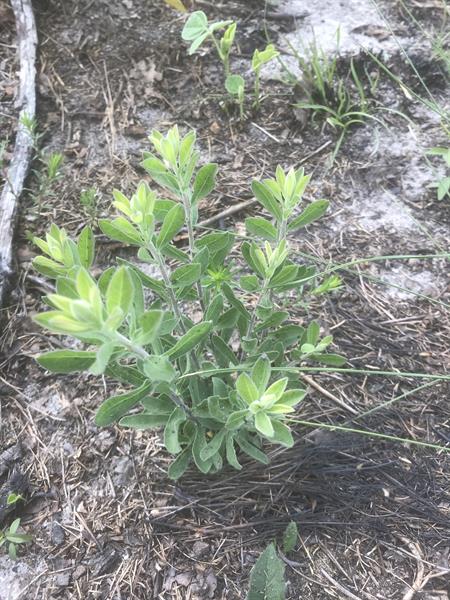
image #4 of Eupatorium glaucescens© Clemson University Herbarium staff | Original Image ⭷
image #5 of Eupatorium glaucescens© Scott Ward, some rights reserved (CC BY), uploaded by Scott Ward source CC-BY | Original Image ⭷
image #6 of Eupatorium glaucescens© Scott Ward, some rights reserved (CC BY), uploaded by Scott Ward source CC-BY | Original Image ⭷
image #8 of Eupatorium glaucescens© Scott Ward, some rights reserved (CC BY), uploaded by Scott Ward source CC-BY | Original Image ⭷
image #9 of Eupatorium glaucescens© Scott Ward, some rights reserved (CC BY), uploaded by Scott Ward source CC-BY | Original Image ⭷

Feedback

See something missing or incorrect about Eupatorium glaucescens? Let us know here:
  1. Please include your name and if possible, email in case when need to clarify what you wrote.
  2. If you opt out of including email, please be as specific as possible (e.g., which photo is incorrect?)
  3. Please do not submit questions asking to identify plants or about horticultural topics (e.g., how do I control an invasive plant in my garden?). Instead, those questions can be submitted here for the Carolinas region only.
  4. Please do not send us feedback about unkeyed species as this work is ongoing.
  5. Please allow time for flora edits to show in our next data release. We greatly appreciate your feedback but may require extra time to research complicated taxonomic issues.

Horticultural Information

NCBG trait

Intro: Erect perennial of sandhills and other dry, sandy woodlands.

Stems: Stems from a woody crown, usually much-branched from the base, minutely hairy.

Leaves: Leaves opposite, sessile, spreading to ascending, oblong-lance-shaped with tapered base, entire or irregularly toothed only in the upper half, gland-dotted beneath and hairy.

Inforescence:

Flowers: Narrow, erect, fuzzy-appearing composite flowers (heads) in branching, terminal cluster, the branches of which are very hairy; heads about 1/3 in. long, each consisting of about 5 tiny, bright white, 5-lobed, tubular florets with 2 protruding styles. A series of hairy, green, narrow bracts surround the base of each head.

Fruits:

Comments: Flowers are notably whiter than those of other white Eupatoriums.

Height: 1-2 1/2 ft.

plant sale text:

bloom table text:

description: Erect perennial of sandhills and other dry, sandy woodlands.

stems: Stems from a woody crown, usually much-branched from the base, minutely hairy.

leaves: Leaves opposite, sessile, spreading to ascending, oblong-lance-shaped with tapered base, entire or irregularly toothed only in the upper half, gland-dotted beneath and hairy.

inflorescence:

flowers: Narrow, erect, fuzzy-appearing composite flowers (heads) in branching, terminal cluster, the branches of which are very hairy; heads about 1/3 in. long, each consisting of about 5 tiny, bright white, 5-lobed, tubular florets with 2 protruding styles. A series of hairy, green, narrow bracts surround the base of each head.

fruits:

comments: Flowers are notably whiter than those of other white Eupatoriums.

cultural notes:

germination code:

native range:


0 unsaved edits on this page.