*Cerastium glomeratum Thuillier. Common name: Sticky Mouse-ear. Phenology: Feb-May. Habitat: Fields, disturbed areas, lawns. Distribution: Native of Europe.
Origin/Endemic status: Europe
Synonymy ⓘ: = Ar, Can, Fl4, FNA5, GrPl, Il, K4, Mi, Mo2, NcTx, NE, NY, Pa, RAB, Tn, Tx, Va, W, WH3; = Cerastium viscosum L. — C, F, G, S, S13, Tat, ambiguous name, of uncertain application. Basionym: Cerastium glomeratum Thuill. 1799
Links to other floras: = Cerastium glomeratum - FNA5
Show parent genus | Show parent in key(s)
Wetland Indicator Status:
- Atlantic and Gulf Coastal Plain: FACU
- Eastern Mountains and Piedmont: UPL
- Great Plains: FACU
- Midwest: FACU
- Northcentral & Northeast: FACU
Heliophily ⓘ: 8
Hover over a shape, letter, icon, or arrow on the map for definition or see the legend.
© Gary P. Fleming | Original Image ⭷
© Erik Danielson source | Original Image ⭷
© Shaun Pogacnik, some rights reserved (CC BY-NC), uploaded by Shaun Pogacnik source CC-BY-NC, permission granted to NCBG | Original Image ⭷
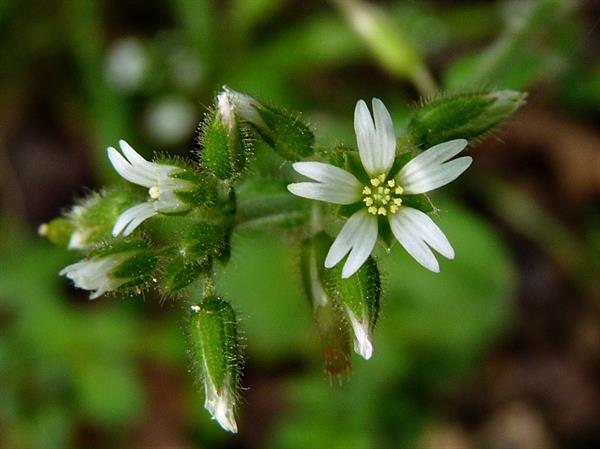
© Matt, some rights reserved (CC BY-NC), uploaded by Matt source CC-BY-NC, permission granted to NCBG | Original Image ⭷
© Aidan Campos source | Original Image ⭷
© Gary P. Fleming | Original Image ⭷
© Alvin Diamond, some rights reserved (CC BY-NC), uploaded by Alvin Diamond source CC-BY-NC, permission granted to NCBG | Original Image ⭷
© Bruce A. Sorrie | Original Image ⭷Feedback
See something missing or incorrect about Cerastium glomeratum? Let us know here:
- Please include your name and if possible, email in case when need to clarify what you wrote.
- If you opt out of including email, please be as specific as possible (e.g., which photo is incorrect?)
- Please do not submit questions asking to identify plants or about horticultural topics (e.g., how do I control an invasive plant in my garden?). Instead, those questions can be submitted here for the Carolinas region only.
- Please do not send us feedback about unkeyed species as this work is ongoing.
- Please allow time for flora edits to show in our next data release. We greatly appreciate your feedback but may require extra time to research complicated taxonomic issues.
Horticultural Information
Intro: Semi-erect to sprawling annual of fields, roadsides and other disturbed habitats. Native of Europe.
Stems: Stems tufted, branching basally, light green to dark purple, covered with white, mostly gland-tipped hairs.
Leaves: Leaves opposite, sessile-clasping, broadly oval to elliptic or lance-shaped, to 1 in. long, covered with long, white hairs on both surfaces.
Inforescence:
Flowers: Flowers in compact clusters at tips of branches, white, about 1/4 in. wide, with 5 deeply notched petals; 5 hairy, green, pointed sepals; 10 white stamens and a pistil with 5 styles.
Fruits: Fruit a cylindrical capsule.
Comments:
Height: 2-18 in.
plant sale text:
bloom table text:
description: Semi-erect to sprawling annual of fields, roadsides and other disturbed habitats. Native of Europe.
stems: Stems tufted, branching basally, light green to dark purple, covered with white, mostly gland-tipped hairs.
leaves: Leaves opposite, sessile-clasping, broadly oval to elliptic or lance-shaped, to 1 in. long, covered with long, white hairs on both surfaces.
inflorescence:
flowers: Flowers in compact clusters at tips of branches, white, about 1/4 in. wide, with 5 deeply notched petals; 5 hairy, green, pointed sepals; 10 white stamens and a pistil with 5 styles.
fruits: Fruit a cylindrical capsule.
comments:
cultural notes:
germination code:
native range:
0 unsaved edits on this page.