 *Pueraria montana (Loureiro) Merrill var. lobata (Willdenow) Maesen & S.M. Almeida ex Sanjappa & Predeep. Kudzu. Phen: Jul-Oct. Hab: Roadsides, waste areas. Dist: Native of e. Asia.
Origin/Endemic status: E. and se. Asia
Taxonomy Comments: Two other varieties occur in e. Asia.
Other Comments: Kudzu was strongly promoted in the 1920's and 1930's in the Southeastern United States as a stabilizer of eroded areas. Hundreds of Kudzu Clubs formed, and Kudzu Songbooks were published. It is now notorious as a weed and symbol of the South. Despite its notoriety in the popular press, kudzu is an ecologically relatively trivial (though conspicuous) weed, since it rarely produces viable seeds in our area, and generally does not invade high quality natural areas. The thickened rhizome can weigh as much as 150 kg, and is the source of a high quality cooking starch prized in Asia. The purple flowers smell like artificial grape flavoring. The leaves are very frost-sensitive.
Synonymy: = Ar, FNA11.1, K1, K3, K4, Mi, NcTx, NE, NY, Tn, Va, WH3, Isely (1998), Ward (1998); = Pueraria lobata (Willd.) Ohwi – C, F, G, GrPl, Pa, RAB, SE3, Tx, W, WV; = Pueraria thunbergiana (Siebold & Zucc.) Benth. – S, Tat; < Pueraria montana (Lour.) Merr. – Il
Wetland Indicator Status:
- Atlantic and Gulf Coastal Plain: FACU (name change)
- Eastern Mountains and Piedmont: UPL (name change)
- Great Plains: UPL (name change)
- Midwest: UPL (name change)
- Northcentral & Northeast: UPL (name change)
Heliophily: 6
Hover over a shape, letter, icon, or arrow on the map for definition or see the legend.
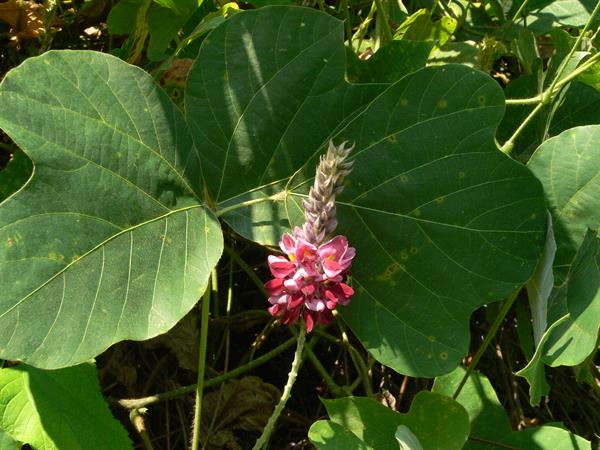 © Bruce A. Sorrie | Original Image ⭷
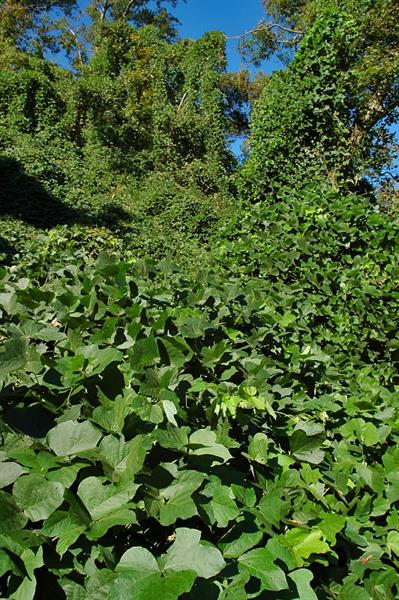 © Gary P. Fleming | Original Image ⭷
 © Scott Ward | Original Image ⭷
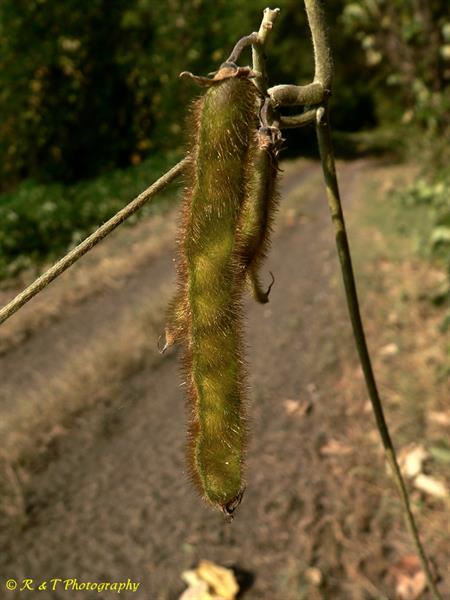 © Richard & Teresa Ware CC-BY-NC, permission granted to NCBG | Original Image ⭷
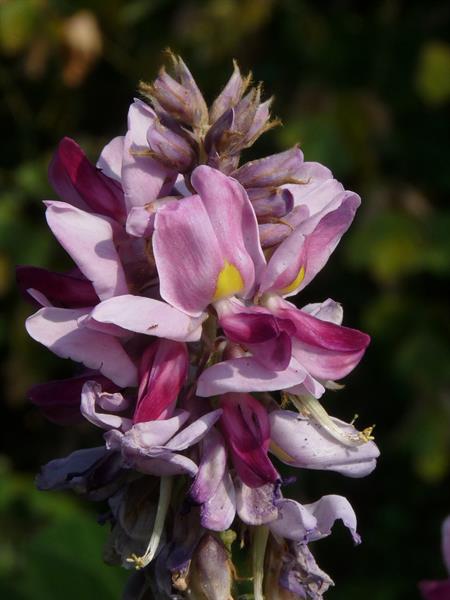 © Richard & Teresa Ware CC-BY-NC, permission granted to NCBG | Original Image ⭷
 © Alan Cressler: Pueraria montana, Noonday Creek, upstream of Highway 92, Cherokee County, Georgia 1 by Alan Cressler source | Original Image ⭷
 © Joey Shaw source | Original Image ⭷
Feedback
See something wrong or missing on about Pueraria montana var. lobata? Let us know here: (Please include your name and email if at all complicated so we can clarify if needed.)
Cite as...