 Campanula Linnaeus. Bellflower.
A genus of about 300-425 species, herbs (rarely shrubby), north temperate, most diverse in s. Europe. The appropriate circumscription remains uncertain and controversial; evidence in recent decades makes clear that species traditionally treated in Campanula (or sometimes in segregates usually not recognized) are more closely related to other genera in Campanuloideae (such as Triodanis, Legousia, Phyteuma, etc.). The option to expand Campanula to include those genera exists and is advocated by Roquest et al. (2008). Alternatively, divergent groups of 'Campanula' can be segregated into monophyletic genera. We here follow Park et al. (2006) and especially (for our region) Morin (2020) in recognizing distinctive and evolutionarily long-separated clades in eastern North America at generic rank. Most of the remaining taxa treated here in Campanula will also be removed from that genus (they are in the rapunculoid clades), but the best way to do so is not yet clear. Campanula latifolia is the type of the genus Campanula.
Ref: Lammers In Kadereit & Jeffrey (2007); Morin (2020); Park et al. (2006); Roquet et al. (2008); Rosatti (1986); Shetler (1982); Shetler & Morin (1986); Shulkina, Gaskin, & Eddie (2003); Sutherland & Galloway (2018); Wilson et al. (2020). Show full citations.
Hover over a shape, letter, icon, or arrow on the map for definition or see the legend. Data for arrows not developed for genera and families which may have species only occurring outside the flora area.
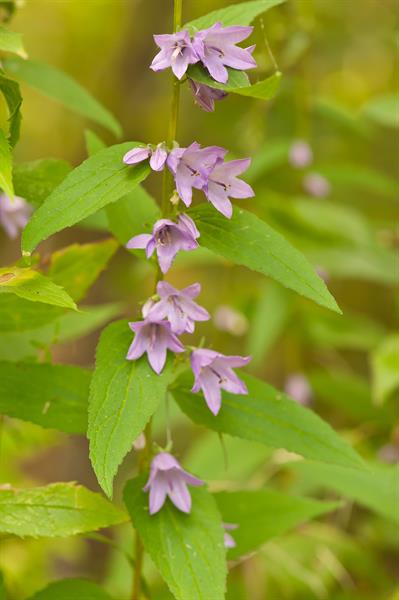 © Keith Bradley | Campanula rapunculoides | Original Image ⭷
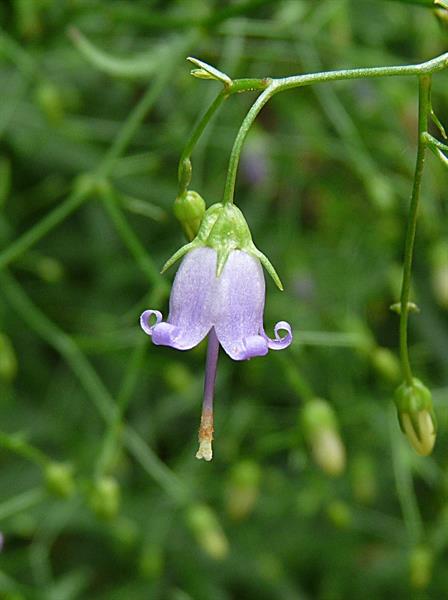 © Richard & Teresa Ware | Campanula divaricata CC-BY-NC, permission granted to NCBG | Original Image ⭷
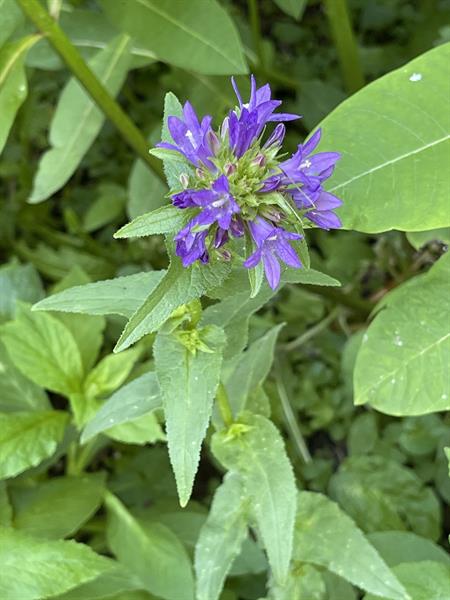 © Sara Patton, some rights reserved (CC BY), uploaded by Sara Patton | Campanula glomerata source | Original Image ⭷
Feedback
See something wrong or missing on about Campanula? Let us know here: (Please include your name and email if at all complicated so we can clarify if needed.)
Cite as...