 Phacelia A.L. de Jussieu. Phacelia.
A genus of about 100-200 species, of North America and South America, concentrated in w. North America.
ID notes:1. Phacelia bipinnatifida and Hydrophyllum virginianum are sometimes confused. P. bipinnatifida has the larger and more basal leaves distinctly bipinnatifid, the lower pinnae often stalked (vs. pinnatifid, the basal or terminal pinnae sometimes 2-lobed, all the pinnae more-or-less sessile), pubescence of the upper stem and inflorescence in part glandular (pubescence nonglandular), and seeds 4 per capsule, black (vs. 2 per capsule, light brown). 2. Phacelia covillei and P. ranunculacea are superficially similar to and sometimes confused with Nemophila aphylla, which see for discussion.
Ref: Constance (1949); Gillett (1964); Gillett (1968); Hofmann et al. In Kadereit & Bittrich (2016); Levy (1991a); Levy (2021); Levy & Malone (2001); Levy, Hou, & Taylor-Bennetts (2021); Murdy (1966); Sewell & Vincent (2006). Show full citations.
Hover over a shape, letter, icon, or arrow on the map for definition or see the legend. Data for arrows not developed for genera and families which may have species only occurring outside the flora area.
 © Will Stuart | Phacelia bipinnatifida | Original Image ⭷
 © Keith Bradley | Phacelia fimbriata | Original Image ⭷
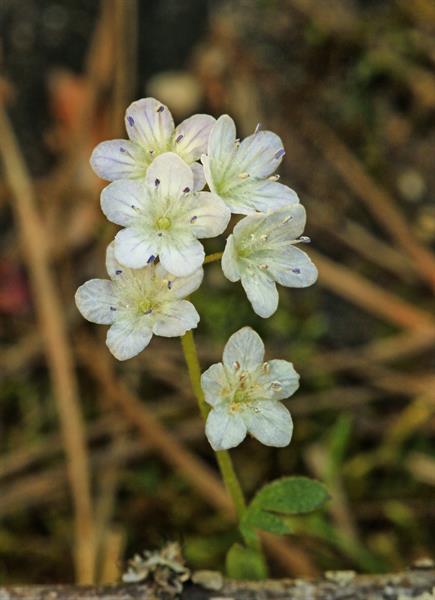 © Alan M. Cressler | Phacelia dubia var. dubia | Original Image ⭷
 © Bruce A. Sorrie | Phacelia covillei | Original Image ⭷
 © Richard & Teresa Ware | Phacelia bipinnatifida CC-BY-NC, permission granted to NCBG | Original Image ⭷
 © Richard & Teresa Ware | Phacelia bipinnatifida CC-BY-NC, permission granted to NCBG | Original Image ⭷
 © Edwin Bridges | Phacelia fimbriata | Original Image ⭷
 © Bruce A. Sorrie | Phacelia congesta | Original Image ⭷
Feedback
See something wrong or missing on about Phacelia? Let us know here: (Please include your name and email if at all complicated so we can clarify if needed.)
Cite as...