 Rudbeckia Linnaeus. Yellow Coneflower, Black-eyed Susan.
A genus of about 25 or more species, herbs, of North America.
Key advice:This treatment needs considerable additional work in the herbarium, and will likely be substantially modified. Pales are receptacular bracts which subtend all or some of the disc florets of capitulum. They differ from phyllaries in that they subtend individual florets atop the receptacle vs. phyllaries which subtend the entire head of flowers. They are present within some, but not all, Asteraceae genera, and are most common in the Heliantheae tribe.
Ref: Campbell & Seymour (2013); Cronquist (1980); Kelley (2023a); Perdue (1957); Urbatsch & Cox (2006a) In Flora of North America Editorial Committee (2006c). Show full citations.
Hover over a shape, letter, icon, or arrow on the map for definition or see the legend. Data for arrows not developed for genera and families which may have species only occurring outside the flora area.
 © Gary P. Fleming | Rudbeckia heliopsidis | Original Image ⭷
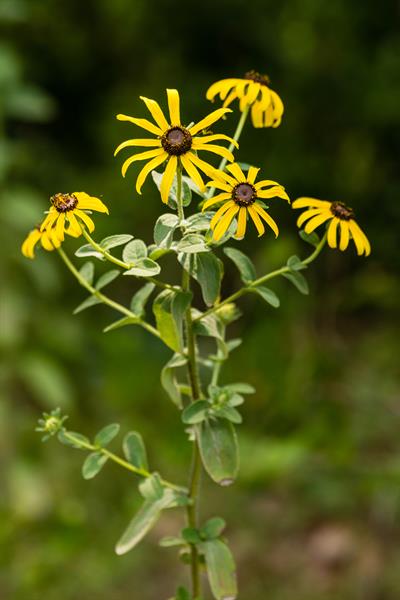 © Keith Bradley | Rudbeckia mollis | Original Image ⭷
 © Gary P. Fleming | Rudbeckia laciniata var. bipinnata | Original Image ⭷
 © Gary P. Fleming | Rudbeckia triloba var. triloba | Original Image ⭷
 © Gary P. Fleming | Rudbeckia laciniata var. bipinnata | Original Image ⭷
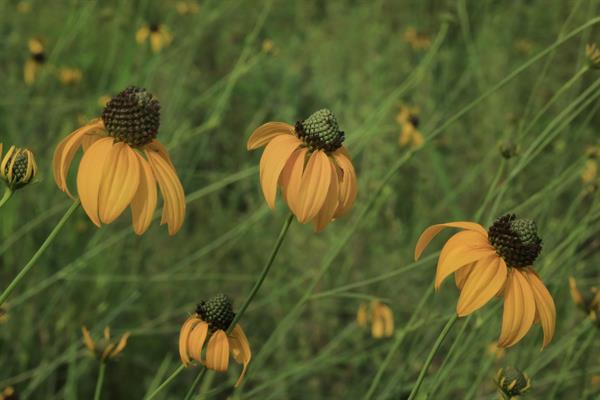 © Alan M. Cressler | Rudbeckia mohrii | Original Image ⭷
 © Sonnia Hill | Rudbeckia maxima | Original Image ⭷
 © Shaun Pogacnik, some rights reserved (CC BY-NC), uploaded by Shaun Pogacnik | Rudbeckia deamii source | Original Image ⭷
 © Shaun Pogacnik, some rights reserved (CC BY-NC), uploaded by Shaun Pogacnik | Rudbeckia deamii source | Original Image ⭷
Feedback
See something wrong or missing on about Rudbeckia? Let us know here: (Please include your name and email if at all complicated so we can clarify if needed.)
Cite as...