 Tamala Rafinesque. Bay, Red-bay.
A genus of 3 species (or possibly more, depending on circumscription), trees and large shrubs, of se. North America and the Bahamas. Song et al. (2020), Xiao, Yan, & Ge (2022), and other recent phylogenetic studies showed that the current circumscription of Persea is untenable, and our three native species should be placed in another genus, Tamala (as done by Small 1933). The affinities of Tamala appear to be with Asian genera (Nothaphoebe, Dehaasia, and Alseodaphne), not with Persea s.s., this grouping termed "Clade I" by Xiao, Yan, & Ge (2022). Tamala Raf. 1838 has nomenclatural priority over all other genera in the clade, so even if a lumping approach were taken (which would not be desirable, given the morphological distinctions of the genera), our Southeastern plants should be treated as Tamala, not as Persea (the type of which, Persea americana, is is in Clade II).
Ref: Clewell (1985); Godfrey (1988); Rohwer (1993a) In Kubitzki, Rohwer, & Bittrich (1993); Shearman, Wang, & Mayfield (2022); Small (1933); Song et al. (2020); Weakley (2023a) In Weakley et al. (2023); Wofford (1997b) In Flora of North America Editorial Committee (1997); Xiao, Yan, & Ge (2022). Show full citations.
Hover over a shape, letter, icon, or arrow on the map for definition or see the legend. Data for arrows not developed for genera and families which may have species only occurring outside the flora area.
 © Gary P. Fleming | Tamala palustris | Original Image ⭷
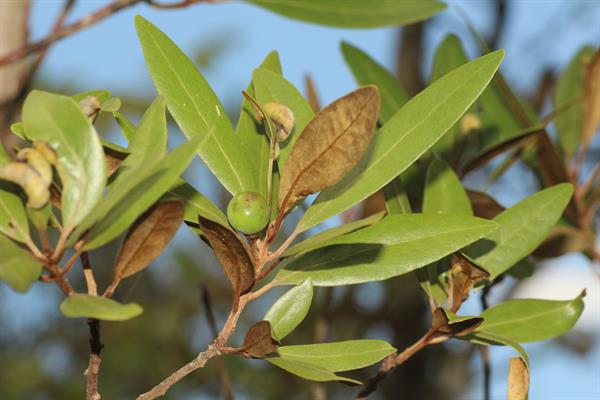 © Scott Ward | Tamala humilis | Original Image ⭷
 © Adam Arendell | Tamala borbonia | Original Image ⭷
 © Jay Horn | Tamala palustris source
 © Jay Horn | Tamala palustris source | Original Image ⭷
Feedback
See something wrong or missing on about Tamala? Let us know here: (Please include your name and email if at all complicated so we can clarify if needed.)
Cite as...