Polygonatum pubescens (Willdenow) Pursh. Common name: Downy Solomon’s-seal, Hairy Solomon’s-seal. Phenology: Late Apr-Jun; Aug-Oct. Habitat: Moist forests, especially cove forests, but also in montane oak forests. Distribution: S. QC west to s. MB, south to nw. SC (S. Tessel, pers.comm., 2023), n. GA, ne. AL, IN, ne. IA, and MN.
Origin/Endemic status: Native
Synonymy ⓘ: = C, Can, F, FNA26, G, Il, K4, Mi, NE, NS, NY, Pa, POWO, RAB, Tat, Tn, Va, W, WV, Judd (2003), Ownbey (1944); = Polygonatum biflorum (Walter) Elliott — S, misapplied. Basionym: Convallaria pubescens Willd. 1803
Links to other floras: = Polygonatum pubescens - FNA26
Show parent genus | Show parent in key(s)
Wetland Indicator Status:
- Atlantic and Gulf Coastal Plain: FACU
- Eastern Mountains and Piedmont: FACU
- Great Plains: FACU
- Midwest: FACU
- Northcentral & Northeast: FACU
Heliophily ⓘ: 2
Hover over a shape, letter, icon, or arrow on the map for definition or see the legend.
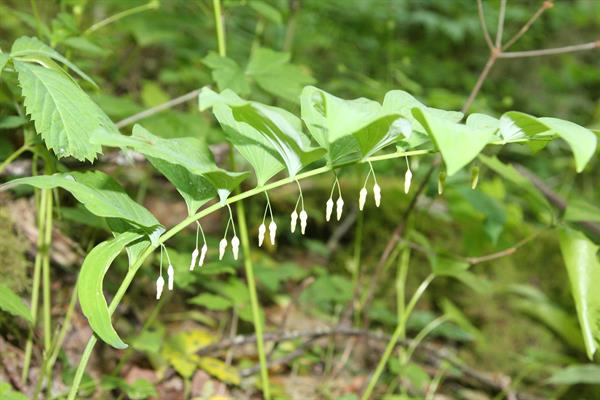
© Bruce A. Sorrie | Original Image ⭷
© Gary P. Fleming | Original Image ⭷
© Alan Cressler: Polygonatum pubescens, Mount Enotah, Brasstown Bald Wilderness, Chattahoochee National Forest, Towns County, Georgia 1 by Alan Cressler source | Original Image ⭷
© Erik Danielson source | Original Image ⭷
© Joey Shaw source | Original Image ⭷
© Erik Danielson source | Original Image ⭷Feedback
See something missing or incorrect about Polygonatum pubescens? Let us know here:
- Please include your name and if possible, email in case when need to clarify what you wrote.
- If you opt out of including email, please be as specific as possible (e.g., which photo is incorrect?)
- Please do not submit questions asking to identify plants or about horticultural topics (e.g., how do I control an invasive plant in my garden?). Instead, those questions can be submitted here for the Carolinas region only.
- Please do not send us feedback about unkeyed species as this work is ongoing.
- Please allow time for flora edits to show in our next data release. We greatly appreciate your feedback but may require extra time to research complicated taxonomic issues.
Horticultural Information
Intro: Erect, arching perennial of moist forests, especially cove forests, but also in montane oak forests.
Stems: Stems unbranched, smooth; there are sheathing, papery bracts on the lower, leafless part of stem.
Leaves: Leaves narrowly elliptic to oval, short-petiolate, 1 1/2-5 in. long, whitish and hairless above, with 3-9 finely hairy veins beneath.
Inforescence:
Flowers: Flowers dangling below leaf from slender stalks originating in leaf axils (1-2 per axil); yellow-green; 3/8-1/2 in. long; tubular, with 6 short, pointed, spreading tepal lobes.
Fruits: Fruit a round, blue-black berry.
Comments:
Height: 1-2.5 ft.
plant sale text: What a delightfully understated plant! Simple green elliptic leaves emerge in spring along bright green gently arching zig-zag stems. Flowers are to be found in mid- to late spring below the leaves; narrow pale greenish white bells, flared at their rims. The blue-black rounded fruits follow on in summer. This is an open woodland plant, liking some sun and some shade, loamy soil with decaying organic material when available. The knotty half-inch thick rhizomes will spread out a bit in time and form a tidy colony of arches where happy.
bloom table text:
description: Erect, arching perennial of moist forests, especially cove forests, but also in montane oak forests.
stems: Stems unbranched, smooth; there are sheathing, papery bracts on the lower, leafless part of stem.
leaves: Leaves narrowly elliptic to oval, short-petiolate, 1 1/2-5 in. long, whitish and hairless above, with 3-9 finely hairy veins beneath.
inflorescence:
flowers: Flowers dangling below leaf from slender stalks originating in leaf axils (1-2 per axil); yellow-green; 3/8-1/2 in. long; tubular, with 6 short, pointed, spreading tepal lobes.
fruits: Fruit a round, blue-black berry.
comments:
cultural notes:
germination code:
native range: northeastern North America
0 unsaved edits on this page.