Copy permalink to share

Isotria medeoloides (Pursh) Rafinesque. Common name: Small Whorled Pogonia, Little Five-leaves. Phenology: May-Jun. Habitat: Acidic mesic to dry-mesic forests, in the mountains and upper Piedmont usually with Pinus strobus. Distribution: Widespread (but very local) in ne. North America, from s. ME and MI south to c. and e. WV, w. VA, w. NC, e. TN, and n. GA.

Origin/Endemic status: Native

Other Comments: The reproductive biology of this species was studied by Vitt & Campbell (1997). Van Alstine et al. (1996) discussed the habitats of known occurrences in Virginia.

Synonymy : = C, Can, F, FNA26, G, Il, K4, Mi, Mo1, NE, NS, NY, Pa, POWO, RAB, Tn, Va, W, Correll (1950), Luer (1975); = Isotria affinis (Austin) Rydb. — S; = n/a — S13, Tat; = Pogonia affinis Austin. Basionym: Arethusa medeoloides Pursh 1814

Links to other floras: = Isotria medeoloides - FNA26

Show in key(s)

Show parent genus | Show parent in key(s)

Wetland Indicator Status:

  • Atlantic and Gulf Coastal Plain: FACU
  • Eastern Mountains and Piedmont: FACU
  • Midwest: FACU
  • Northcentral & Northeast: FACU

Heliophily : 2

Your browser does not support SVGs

Hover over a shape, letter, icon, or arrow on the map for definition or see the legend.

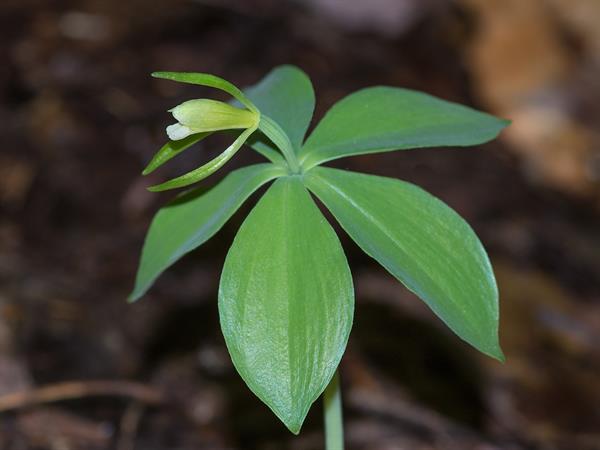
image of plant© Jim Fowler | Original Image ⭷

Feedback

See something missing or incorrect about Isotria medeoloides? Let us know here:

  1. Please include your name and if possible, email in case when need to clarify what you wrote.
  2. If you opt out of including email, please be as specific as possible (e.g., which photo is incorrect?)
  3. Please do not submit questions asking to identify plants or about horticultural topics (e.g., how do I control an invasive plant in my garden?). Instead, those questions can be submitted here for the Carolinas region only.
  4. Please do not send us feedback about unkeyed species as this work is ongoing.
  5. Please allow time for flora edits to show in our next data release. We greatly appreciate your feedback but may require extra time to research complicated taxonomic issues.

Horticultural Information

NCBG trait

Intro: Erect perennial of acidic moist or dry-to-moist forests, in the Mountains and upper Piedmont usually with Pinus strobus.

Stems: Stem unbranched, whitish-green with a powdery coating.

Leaves: Leaves in a whorl at top of stem where flowering stalk begins, elliptic to elliptic-ovate, 1-2 1/2 in. long, often drooping, light green.

Inforescence:

Flowers: Flowers 1--2 on a stalk emerging from the center of the leaf whorl, bilaterally symmetric, consisting of 3 green, spreading, linear-oblong sepals (½--1¼ in. long), 2 yellowish-greenish petals forming a hood, and a white, slightly down-curved lip-petal with wavy-edged tip and yellowish-green bumps (crests).

Fruits: Fruit a ribbed, elliptical capsule.

Comments:

Height: 3-10 in.

plant sale text:

bloom table text:

description: Erect perennial of acidic moist or dry-to-moist forests, in the Mountains and upper Piedmont usually with Pinus strobus.

stems: Stem unbranched, whitish-green with a powdery coating.

leaves: Leaves in a whorl at top of stem where flowering stalk begins, elliptic to elliptic-ovate, 1-2 1/2 in. long, often drooping, light green.

inflorescence:

flowers: Flowers 1--2 on a stalk emerging from the center of the leaf whorl, bilaterally symmetric, consisting of 3 green, spreading, linear-oblong sepals (½--1¼ in. long), 2 yellowish-greenish petals forming a hood, and a white, slightly down-curved lip-petal with wavy-edged tip and yellowish-green bumps (crests).

fruits: Fruit a ribbed, elliptical capsule.

comments:

cultural notes:

germination code:

native range:


0 unsaved edits on this page.