 Woodsia R. Brown. Woodsia, Cliff Fern.
A genus of about 65 species, of temperate and cool-temperate regions, widespread in the Northern Hemisphere, in montane tropical South America and Africa. Recent proposals have been made, based on molecular and morphological data, to split Woodsia into 2 or more genera (Shmakov 2015; Lu et al. (2020). They have merit, but we hold with a broad circumscription of Woodsia until a consensus develops.
ID notes:Woodsia species and Cystopteris species are all small ferns with thin-textured leaves, occurring primarily on or near rock outcrops; they frequently occur together or in proximity to one another and are often confused. Woodsia has the indusium divided into a series of scale-like or hair-like structures, attached below the sorus; Cystopteris has an undivided indusium, pocket-like or hood-like, attached around one side of the sorus. Woodsia has persistent dark petiole bases; in Cystopteris the petiole bases are deciduous. Woodsia has the final veinlets not reaching the margin; Cystopteris veins do reach the margin.
Ref: Kramer & Green (1990); Lin et al. (2013); Lu et al. (2020); PPG I (2016); Shmakov (2015); Windham (1993d) In Flora of North America Editorial Committee (1993b). Show full citations.
Hover over a shape, letter, icon, or arrow on the map for definition or see the legend. Data for arrows not developed for genera and families which may have species only occurring outside the flora area.
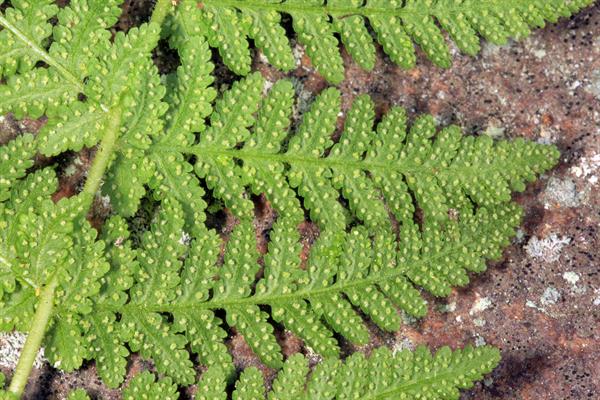 © Alan M. Cressler | Woodsia appalachiana | Original Image ⭷
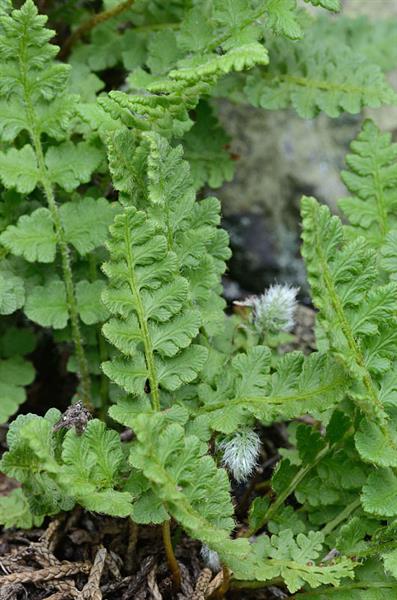 © Gary P. Fleming | Woodsia ilvensis | Original Image ⭷
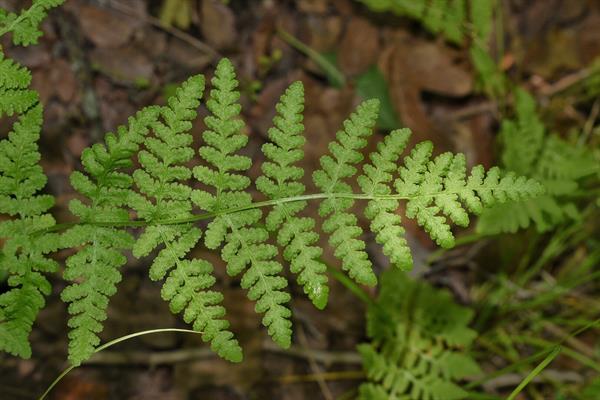 © Aidan Campos | Woodsia obtusa ssp. occidentalis source | Original Image ⭷
Feedback
See something wrong or missing on about Woodsia? Let us know here: (Please include your name and email if at all complicated so we can clarify if needed.)
Cite as...