Click the number at the start of a key lead to highlight both that lead and its corresponding lead. Click again to show only the two highlighted leads. Click a third time to return to the full key with the selected leads still highlighted.
1 Flowers bright yellow (fading brown); [subgenus Chronosemium]. |
..2 Leaves palmately trifoliolate (all leaflets essentially sessile); heads 10-13 mm in diameter; flowers 5-7 mm long |
..2 Leaves pinnately trifoliolate (the lateral leaflets essentially sessile, the terminal leaflet with a petiolule 0.8-3 mm long); heads 5-13 mm in diameter; flowers 2.5-5 mm long. |
....3 Standard with 5 obvious diagonal veins (striations); heads 8-13 mm in diameter, generally with 20-30 flowers; flowers 3.5-5 mm long; petiolule of the terminal leaflet 1-3 mm long |
....3 Standard inconspicuously veined; heads 5-8 mm in diameter, generally with 5-15 (-20) flowers; flowers 2.5-3.5 mm long; petiolule of the terminal leaflet ca. 1 mm long |
1 Flowers white, pink, purplish, or red; [subgenus Trifolium]. |
......4 Flowers borne on distinct pedicels, (1-) 2-10 mm long, these often curving or reflexing in age; flowers white, fading pink with age in most species; [native and exotic species]; [section Lotoidea]. |
........5 Plants stoloniferous, all or some of the leaves alternate from ground level and long petioled. |
..........6 Calyx lobes narrowly triangular, about as long as the calyx tube; peduncles axillary along the stolons; stipules scarious-membranaceous; [plant an abundant introduced weed] |
..........6 Calyx lobes subulate, distinctly longer than the calyx tube; peduncles terminal, either at tips of the stolons, or at tips of erect flowering branches; stipules green, foliaceous; [plants rare natives]. |
............ 7 Peduncle terminal, at the tip of the stolon, lacking leaves; pedicels 2-3 mm long |
............ 7 Peduncle terminal at tip of erect flowering branches, subtended by a pair of opposite or subopposite, short-petioled leaves; pedicels (2-) 4-8 mm long |
........5 Plants not stoloniferous, clumped (though sometimes with prostrate or lax stems). |
............ ..8 Calyx lobes narrowly triangular, about as long as the calyx tube (or longer in T. hybridum); stipules scarious-membranaceous; [plants introduced]. |
............ ....9 Calyx lobes not scarious-margined, straight, equal to or longer than the tube |
............ ....9 Calyx lobes scarious-margined, becoming divergent and twisted, about equal to the tube |
............ ..8 Calyx lobes subulate to lanceolate, distinctly longer than the calyx tube; stipules green, foliaceous; [plants rare natives]. |
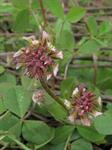 Show caption*© Alan Cressler: Trifolium carolinianum, Heggie's Rock, Heggie's Rock Preserve, The Nature Conservancy, Columbia County, Georgia 1 by Alan Cressler Show caption*© Alan Cressler: Trifolium carolinianum, Heggie's Rock, Heggie's Rock Preserve, The Nature Conservancy, Columbia County, Georgia 1 by Alan Cressler ............ ......10 Flowers 4-6 mm long; calyx lobes lanceolate, foliaceous, 3-nerved, 0.4-0.8 mm wide |
............ ......10 Flowers 8-12 mm long; calyx lobes subulate, setaceous, 1-nerved, < 0.4 mm wide. |
............ ........11 Leaflets 3-7× as long as wide; stems prostrate; flowers creamy white and purple-veined; plant a perennial; [plants of shale barrens and other rock outcrops, from VA northward] |
............ ........11 Leaflets 1-2.8× as long as wide; stems erect, ascending, or decumbent; flowers white or purplish; plant an annual or biennial; [plants of a variety of natural woodlands, collectively widespread in our area] |
............ ..........12 Plant decumbent; terminal petiole 5.7-8.2 cm long; sepal lobes 0.2-0.37 cm long; peduncles 0.23-0.31× as long as the terminal petiole; [dry limestone woodlands, Bluegrass region of KY (so far as is known)] |
............ ..........12 Plant ascending to erect; terminal petiole 0.3-3.5 cm long; sepal lobes 0.3-0.7 cm long; peduncles 0.4-4.2× as long as the terminal petiole; [various woodlands and barrens, widespread in our region (at least formerly)] |
......4 Flowers sessile or on very short pedicels (usually < 1 mm long); flowers pink, purplish, white, or scarlet; [exotic species]. |
............ ............ 13 Plants stoloniferous, all or some of the leaves alternate from ground level and long petioled. |
............ ............ ..14 All flowers with petals; fruiting heads enlarging, becoming a reddish brown, pubescent ball ca. 2 cm in diameter, remaining aerial; [section Vesicaria] |
............ ............ ..14 Only 2-5 outer flowers of the head with petals, the others lacking petals and sterile; fruiting heads becoming a subterranean bur, buried by downward curvature and growth of the peduncle; [section Trichocephalum] |
............ ............ 13 Plants not stoloniferous, the leaves clustered at or near ground level and/or produced on aerial stems. |
............ ............ ....15 Heads subtended by a pseudo-involucre of 2 (-3) enlarged stipules and/or opposite or subopposite leaves; [section Trifolium]. |
............ ............ ......16 Flowers white (fading pink), 7-8 mm long; calyx tube both externally glabrous and 20-nerved |
............ ............ ......16 Flowers red, pink-purple, or bicolored, either 11-20 mm long or 4-6 mm long; calyx tube not both externally glabrous and 20-nerved (externally pubescent, or 10-nerved, or both). |
............ ............ ........17 Flowers 4-6 mm long |
............ ............ ........17 Flowers 11-20 mm long. |
............ ............ ..........18 Stipules gradually tapering to a long slender tip, longer than the fused part; calyx densely hirsute; stem soft pubescent with deflexed to spreading hairs |
............ ............ ..........18 Stipules abruptly narrowed to a short awn; calyx glabrous to pilose; stem appressed pubescent |
............ ............ ....15 Heads not subtended by a pseudo-involucre of leaves or expanded stipules. |
............ ............ ............ 19 Heads axillary, sessile, in the axils of subtending leaves; calyx tube glabrous (except for a few hairs at apex); [section Lotoidea] |
............ ............ ............ 19 Heads terminal or axillary; calyx tube pubescent. |
............ ............ ............ ..20 Calyx bladdery-inflated in fruit; corolla resupinate (inverted 180 degrees, such that the standard is lowermost); [section Vesicaria]. |
............ ............ ............ ....21 Inflorescence with a prominent peduncle; head lobed in fruit |
............ ............ ............ ....21 Inflorescence subsessile to shortly peduncled; head spherical in fruit |
............ ............ ............ ..20 Calyx not bladdery-inflated in fruit; corolla orientation normal (standard uppermost). |
............ ............ ............ ......22 Corolla 3-6 mm long; [section Trifolium] |
............ ............ ............ ......22 Corolla 10-18 mm long. |
............ ............ ............ ........23 Corolla crimson, 10-13 (-15) mm long; floral bracts absent; heads 1-1.5 (-2) cm in diameter; [section Trifolium] |
............ ............ ............ ........23 Corolla white, 15-18 mm long; floral bracts present; heads 2.5-3 cm in diameter; [section Mistyllus] |