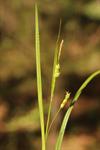
Click the number at the start of a key lead to highlight both that lead and its corresponding lead. Click again to show only the two highlighted leads. Click a third time to return to the full key with the selected leads still highlighted.
1 Basal sheaths purplish, sometimes mixed with brown. |
..2 Widest leaf blade 3-6 mm wide; peduncles of lateral spikes usually drooping |
..2 Widest leaf blade 10-25 mm wide; peduncles of lateral spikes usually erect or spreading. |
....3 Bracts of middle and basal portions of culms with blades 2.1-9.2 cm long; perigynia 5.0-6.6 mm long; longest (per plant) lateral spike with 4-9 perigynia |
....3 Bracts of middle and basal portions of culms bladeless, or with blades 0.1-1.9 cm long; perigynia 3.7-4.9 mm long; longest (per plant) lateral spike with 9-13 perigynia |
1 Basal sheaths brownish, lacking any purple coloration. |
......4 Widest leaf blade 11-25 mm wide; leaf blades of vegetative shoots 3.8-9.0 × as wide as bract leaves; bract blades from middle and basal portions of the culms 2.0-6.2 cm long; foliage glaucous |
......4 Widest leaf blade 2-14 mm wide; leaf blades of vegetative shoots 1.0-3.5 × as wide as bract leaves; bract blades from middle and basal portions of the culms 4.5-24 cm long; foliage green or glaucous. |
........5 Basalmost scale of each lateral spike sterile (lacking a perigynium) or subtending a staminate flower. |
..........6 Foliage usually bright green; longest (per plant) terminal spike 0.6-2.0 (-2.3) cm long; widest leaf blade 5.3-8.3 mm wide |
..........6 Foliage usually glaucous; longest (per plant) terminal spike (1.0-) 1.2-2.5 cm long; widest leaf blade 6.4-11.8 mm wide |
........5 Basalmost scale of each lateral spike subtending a perigynium. |
............ 7 Terminal spikes (1.0-) 1.2-2.7 mm wide; staminate scales acute, those from the middle region of the staminate spike 3.6-5.5 mm long; vegetative shoots shorter than or slightly taller than the culms, the tallest vegetative shoot 0.5-1.3 (-1.8)× as tall as the tallest culm. |
............ ..8 Terminal spike usually surpassing the bract blade of the distalmost lateral spike; longest (per plant) peduncle of terminal spike (6.3-) 8.1-15.9 cm long; widest leaf blade 2.0-2.9 (-3.5) mm wide; each perigynium face 7-10-nerved |
............ ..8 Terminal spike usually surpassed by the bract blade of the distalmost lateral spike; longest (per plant) peduncle of terminal spike 0.9-7.2 (-11.4) cm long; widest leaf blade 2.7-4.5 (-5.3) mm wide; each perigynium face (8-) 11-15-nerved. |
............ ....9 Perigynia 2.5-3.3 mm long, the apex barely excurved |
............ ....9 Perigynia 3.2-4.2 mm long, the apex noticeably excurved |
............ 7 Terminal spikes 0.6-1.4 (-1.6) mm wide; staminate scales obtuse, those from the middle region of the staminate spike 2.6-3.6 (-3.8) mm long; vegetative shoots much taller than the culms, the tallest vegetative shoot (1.4-) 1.7-3.7 (-4.9)× as tall as the tallest culm. |
............ ......10 Perigynia spirally imbricate; longer lateral spikes with (6-) 8-13 perigynia; peduncles of proximal spikes usually erect, the longest (per plant) peduncle (7.0-) 15-42 (-49) mm long; bract blade of distalmost lateral spike 5.6-17 (-26) × as long as wide; loosely or densely cespitose; [primarily of the Coastal Plain in our area, though extending rarely into the Piedmont and Mountains] |
............ ......10 Perigynia distichously imbricate; longer lateral spikes with 4-8 (-9) perigynia; peduncles of proximal spikes usually drooping or nodding, the longest (per plant) peduncle (28-) 44-84 (-91) mm long; bract blade of distalmost lateral spike (12-) 17-51 × as long as wide; densely cespitose; [primarily of the Mountains and Piedmont] |